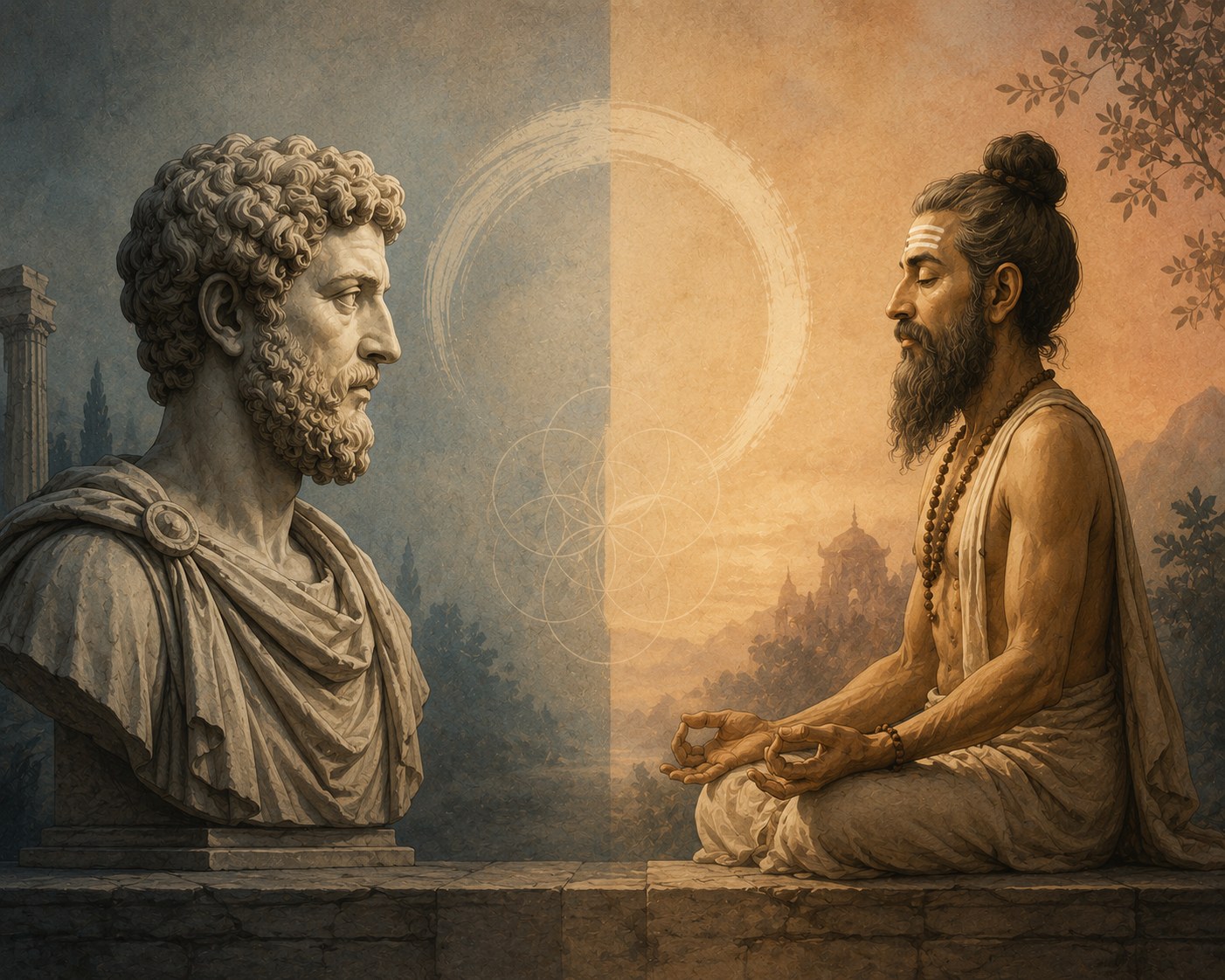
I came to Stoicism through a fairly unexpected door: an interview with Ramiro Calle. At one point he mentioned that the Stoics were, in a way, "the yogis of the West." That line stuck with me for weeks. I'd heard of Marcus Aurelius and Seneca, but not much more. The comparison felt too suggestive to let go.
I started with Marcus Aurelius's Meditations. Then came Seneca, Epictetus, and, more recently, Pierre Hadot, Massimo Pigliucci and Donald Robertson. The more I read, the more I understood what Ramiro Calle meant. Not because yoga and Stoicism are the same thing — they aren't, they emerged from completely different worlds and pursue different goals — but because both treat philosophy as a practice. It's not enough to hold good ideas: you have to train them. A yogi practises āsanas, breathing and meditation. A Stoic practises paying attention to their own judgements, trying to tell apart what's within their control and what isn't, and trying not to lose their head every time reality decides to disagree with them.
That idea felt surprisingly close to yoga. In both cases, the goal isn't to engineer a problem-free life, but to build a certain steadiness for when problems inevitably arrive. Because they do arrive. Sooner or later there's an injury, a layoff, a breakup, a diagnosis, or just an ordinary Monday when everything goes wrong. Neither yoga nor Stoicism promises to prevent those situations. What they offer is a little more readiness for when they come knocking.
Acceptance is not surrender
That said, there's one idea in Stoicism I think is worth unpicking. A lot of people read it as an invitation to resignation: "just accept things and move on." I don't read it that way. The Stoics aren't saying we should endure everything with a beatific smile while the world burns around us. What they propose is far more sensible: don't waste energy fighting what you can't change, and spend it instead where you actually can do something.
Accepting an illness doesn't mean giving up on treatment. Accepting an injustice doesn't mean you stop fighting it. Accepting that you're sad today doesn't mean setting up camp there.
Acceptance is not surrender; it's the starting point from which you can act with a bit of clarity.
Against mandatory happiness
Maybe that's why Stoicism strikes me as a good antidote to a certain contemporary obsession with permanent happiness. We live surrounded by messages promising a life that's always fulfilled, always abundant, always aligned with the universe. If you're not happy, it's probably because you haven't manifested hard enough, you're not vibrating at a high enough frequency, or you haven't bought the right course.
Stoicism — like yoga, when you read it with a bit of calm — is far less flashy, and precisely because of that, far more believable. What it's really saying is something like: "life will go on being complicated; just try not to add unnecessary suffering on top."
Stoicism, hijacked
The curious thing is that, while I was finding all this in Marcus Aurelius or Seneca, the internet seemed to be reading completely different books. In recent years, part of the so-called manosphere has turned Stoicism into a kind of manual for manufacturing alpha males: videos set to epic music, Roman statues, Marcus Aurelius quotes stripped of context, and the promise that if you learn to suppress every emotion you have, you'll end up lifting more weight, making more money, and waking up surrounded by Lamborghinis.
I imagine Marcus Aurelius, who spent a good part of his Meditations reminding himself not to get carried away by his own ego, would watch the whole spectacle with a mix of bewilderment and resignation... very Stoic of him, admittedly.
The irony is that real Stoicism insists, again and again, on humility, compassion, cooperation and service to others. The Stoic sage isn't the one who dominates others, but the one who tries to govern himself.
Why I keep coming back
And maybe that's why I still come back to those books every so often. Not because I think they have an answer for everything, but because they remind me of something fairly simple and fairly difficult at the same time:
Serenity isn't about escaping the world, but about learning to live inside it without breaking at every turn.
Where to start
Classical texts
Contemporary books
And where it all began: the talk by Ramiro Calle that led me to Stoicism, and from whom I borrowed the phrase that gives this piece its title.
Ramiro Calle: talks on yoga, meditation and philosophy of life (in Spanish).