An illustrated history of āsana
A small museum of the body, time and practice. The question running through its rooms is simple: of everything we do today in a yoga class, what's genuinely ancient, and what's a far more recent invention than it looks? To find out, we'll trace each posture back through the texts that document it. And where there's no trace, we'll say so too.
Enter the museum ↓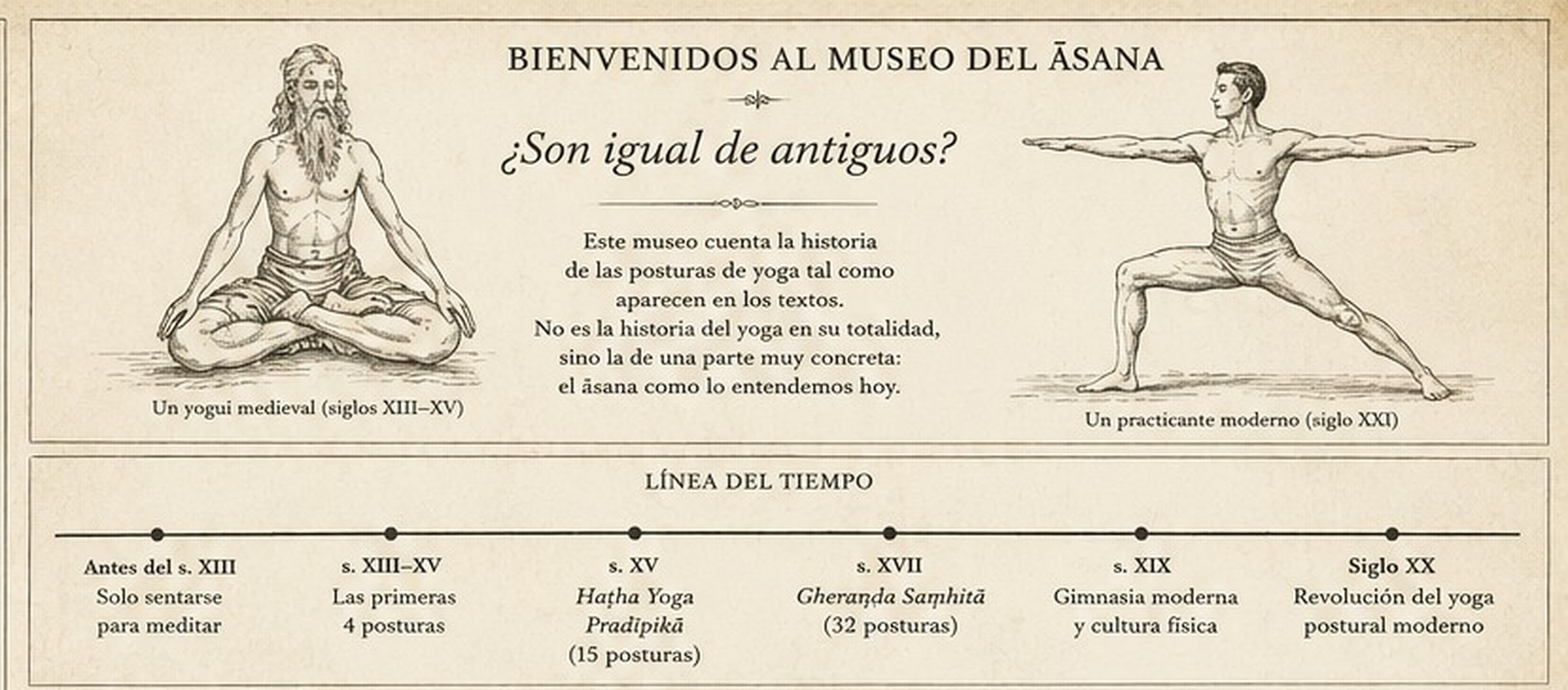
Timeline
When "āsana" just meant sitting
For most of its history, āsana meant, first and foremost, finding a stable way to sit. The body had to stop demanding attention so that breath, concentration and meditation could take centre stage. The idea of a class made up of dozens of linked postures belongs to a much more recent period.
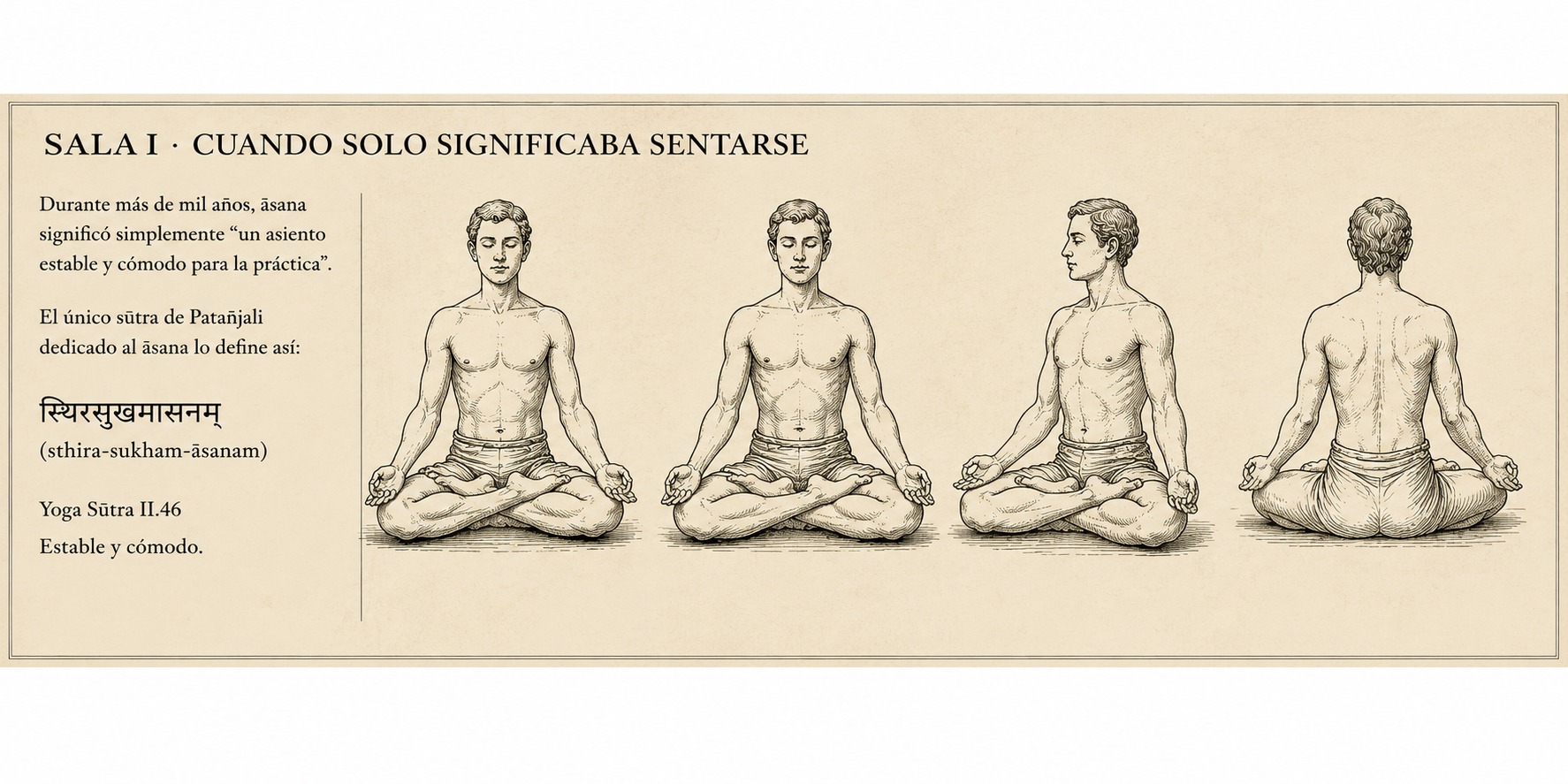
Sitting, before exercising
Early sources aren't chasing postural variety or physical improvement in the modern sense. What matters is being able to stay still without discomfort interrupting the breath or scattering attention. The posture works as a precondition for inner practice.
Ancient continuity"Steady and comfortable"
The single verse Patañjali devotes to āsana in the Yoga Sūtras (probably composed between the 2nd century BCE and the 4th century CE, though the exact dating is still debated) doesn't describe any specific bodily shape:
For over a thousand years, āsana basically meant "finding a stable seat so you can sit down to meditate without the body getting in the way."
8,400,000 postures (but only two)
The Dattātreyayogaśāstra (13th c.), the first text to systematise haṭha yoga under that name, is a good example of how the symbolic number of postures and the number actually described almost never match. This 169-verse Sanskrit text claims, with a touch of devotional hyperbole, that there are 8,400,000 āsanas — as many as there are life forms. But in practice, it only describes one or two postures that aren't simply "sitting": Śavāsana (the corpse) and Viparītakaraṇī (a gentle inversion, halfway between a posture and a mudrā).
What's still missing
We don't yet find a modern-style class with a warm-up, standing sequences, balances and a final relaxation.
The four survivors
Siddhāsana, padmāsana, siṃhāsana and bhadrāsana form one of the oldest postural cores preserved in haṭha yoga literature. They've survived centuries of transmission, though their descriptions and execution don't always line up exactly with what's taught today under those same names.
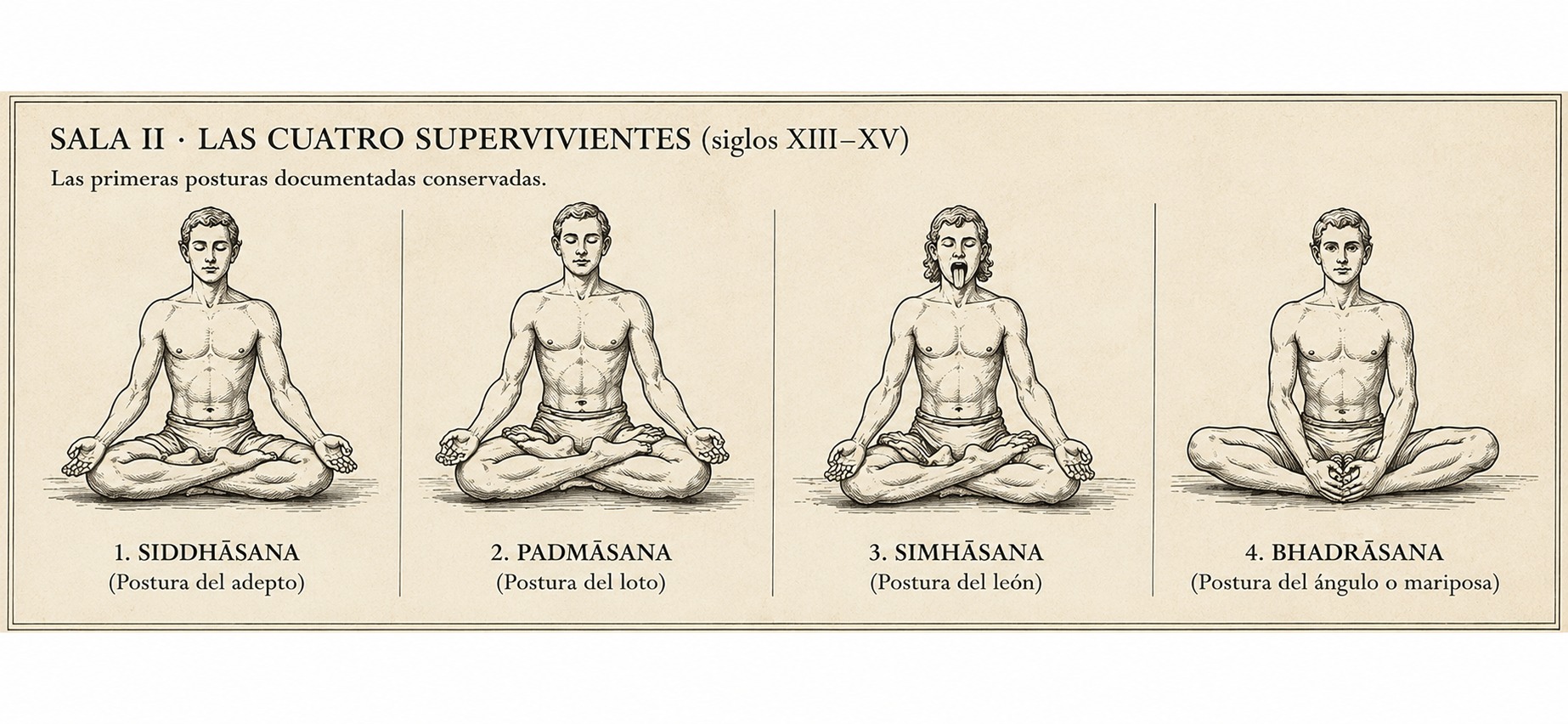
Siddhāsana
Approx. pronunciation: sid-DHAH-sana — meaning: the adept's or accomplished one's posture
One of the seated postures most celebrated by haṭha yoga texts: the Haṭha Yoga Pradīpikā names it, alongside padmāsana, siṃhāsana and bhadrāsana, as one of the four best for sustaining breath and meditation.
Earliest medieval documentationPadmāsana
Approx. pronunciation: pad-MAH-sana — meaning: lotus posture
The lotus became one of the universal images of meditation, though its specific history is complex: it appears described in slightly different ways depending on the text and the period.
Siṃhāsana and bhadrāsana
Siṃhāsana: sim-HAH-sana, "lion posture" — bhadrāsana: BHUD-rah-sana, "auspicious / gracious posture"
Their names have survived, but the exact shape can vary between texts, periods and schools.
The oldest illustrated manuscript
The Bahr al-Ḥayāt ("Ocean of Life," 1600–1604, Chester Beatty Library) is, according to the Smithsonian, the oldest surviving illustrated āsana manuscript. It includes real drawings of vīrāsana, garbhāsana, siddhāsana, a headstand-type inversion and khecarī mudrā, among other practices.

The fifteen of the Haṭha Yoga Pradīpikā
By the 15th century we already find a clearly recognisable repertoire: fifteen postures serving very different functions and levels of demand. There are seated forms, twists, forward folds, arm balances and resting positions. What matters isn't just the number, but the shift in perspective: the body starts becoming a much broader field of practice. Even so, the text doesn't propose a flowing sequence comparable to a contemporary class.
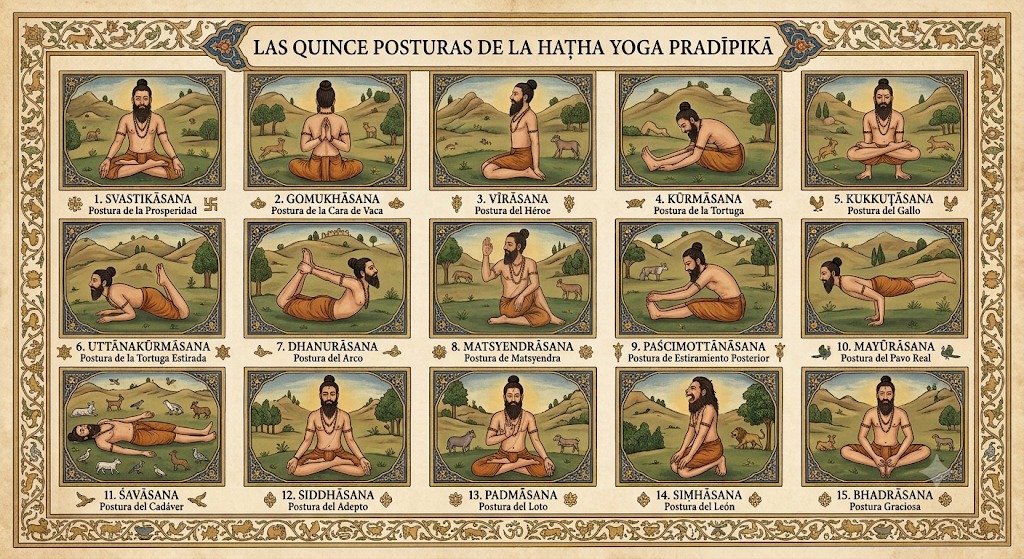
The fifteen, one by one
Svastikāsana · Gomukhāsana · Vīrāsana · Kūrmāsana · Kukkuṭāsana · Uttānakūrmāsana · Dhanurāsana · Matsyendrāsana · Paścimottānāsana · Mayūrāsana · Śavāsana · Siddhāsana · Siṃhāsana · Padmāsana · Bhadrāsana
Complete repertoire from the textHow to read the plate
The illustrations follow a historical-plate aesthetic to make it easier to compare postures. They shouldn't be read as exact photographs of a medieval practice: names, descriptions and forms have all changed over time.
Real zoom
Press "Enlarge plate." You can then use the mouse wheel, the + and − buttons, drag the image, and open it at 100%.
The thirty-two of the Gheraṇḍa Saṃhitā
By the 17th century the repertoire had expanded to thirty-two postures. The body takes on more varied shapes, and extensions, balances, inversions, side bends and resting positions appear more clearly than before. Physical practice gains presence and diversity, but it's still not organised as a modern class. There's still no standardised sequence of warm-up, build-up, peak and cool-down: it's a catalogue, not a choreography.
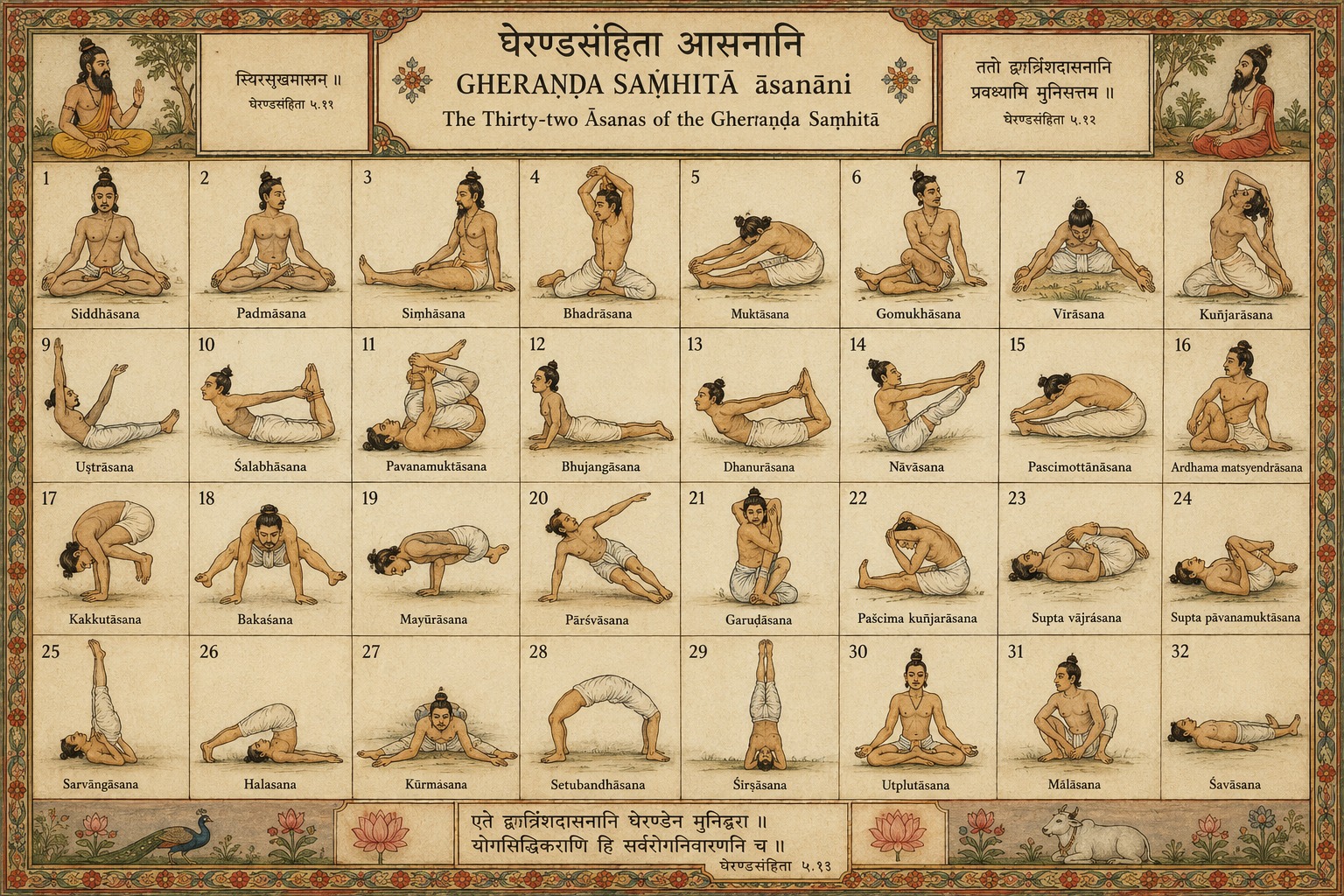
The thirty-two, one by one
Siddhāsana · Padmāsana · Bhadrāsana · Muktāsana · Vajrāsana · Svastikāsana · Siṃhāsana · Gomukhāsana · Vīrāsana · Dhanurāsana · Mṛtāsana · Guptāsana · Matsyāsana · Matsyendrāsana · Gorakṣāsana · Paścimottānāsana · Utkatāsana · Saṅkaṭāsana · Mayūrāsana · Kukkuṭāsana · Kūrmāsana · Uttānakūrmāsana · Uttānamaṇḍūkāsana · Vṛkṣāsana · Maṇḍūkāsana · Garuḍāsana · Vṛṣāsana · Śalabhāsana · Makarāsana · Uṣṭrāsana · Bhujaṅgāsana · Yogāsana
Complete repertoire from the textA much wider catalogue
Seated forms, folds, twists, balances, inversions and extensions all appear here. Even so, they don't add up to a class sequence in today's sense.
A word of caution on equivalences
The plate lets you take in the scope of the repertoire at a glance, but it shouldn't be mistaken for an exact match between each historical form and its contemporary version. In the history of yoga, a name can travel a lot further than a specific shape ever does.
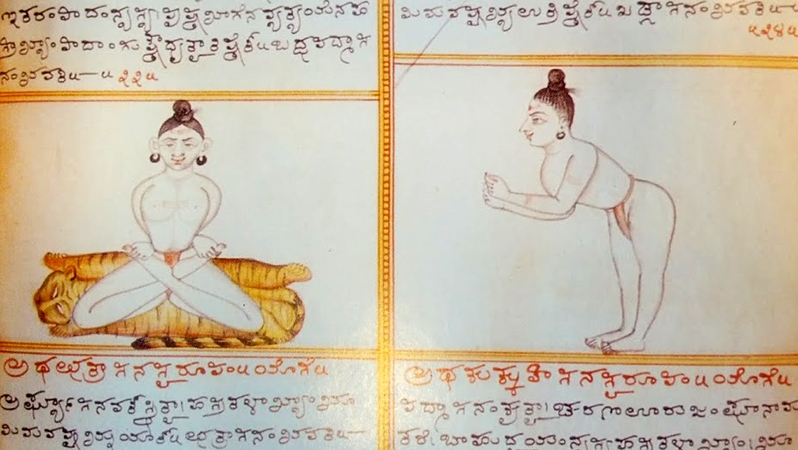
The bridge to Mysore: the Śrītattvanidhi
By the 18th century, texts already existed describing up to 84 āsanas. The Śrītattvanidhi, an early-19th-century manuscript from the Mysore palace library, is one of them — and forms a visual bridge between premodern yoga and Krishnamacharya's Mysore, in the next room.
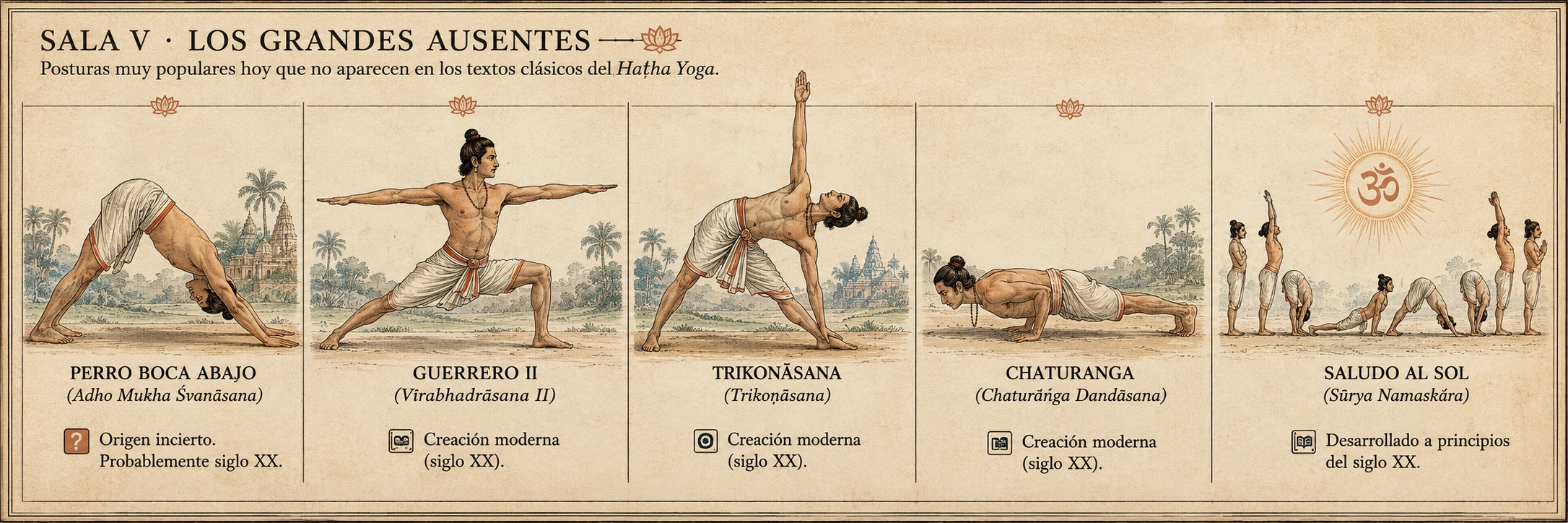
The great absentees
These are central postures in many classes today, but they don't appear as such in the major medieval treatises.
The 20th century reshapes the body of yoga
Gymnastics, physical culture, body education, nationalism and pedagogical creativity all converge in the transformation of postural yoga. In just a few decades, standing postures, transitions and sequences multiply. Yoga also begins to be taught as a systematic method of physical conditioning, adaptable to very different groups and students.
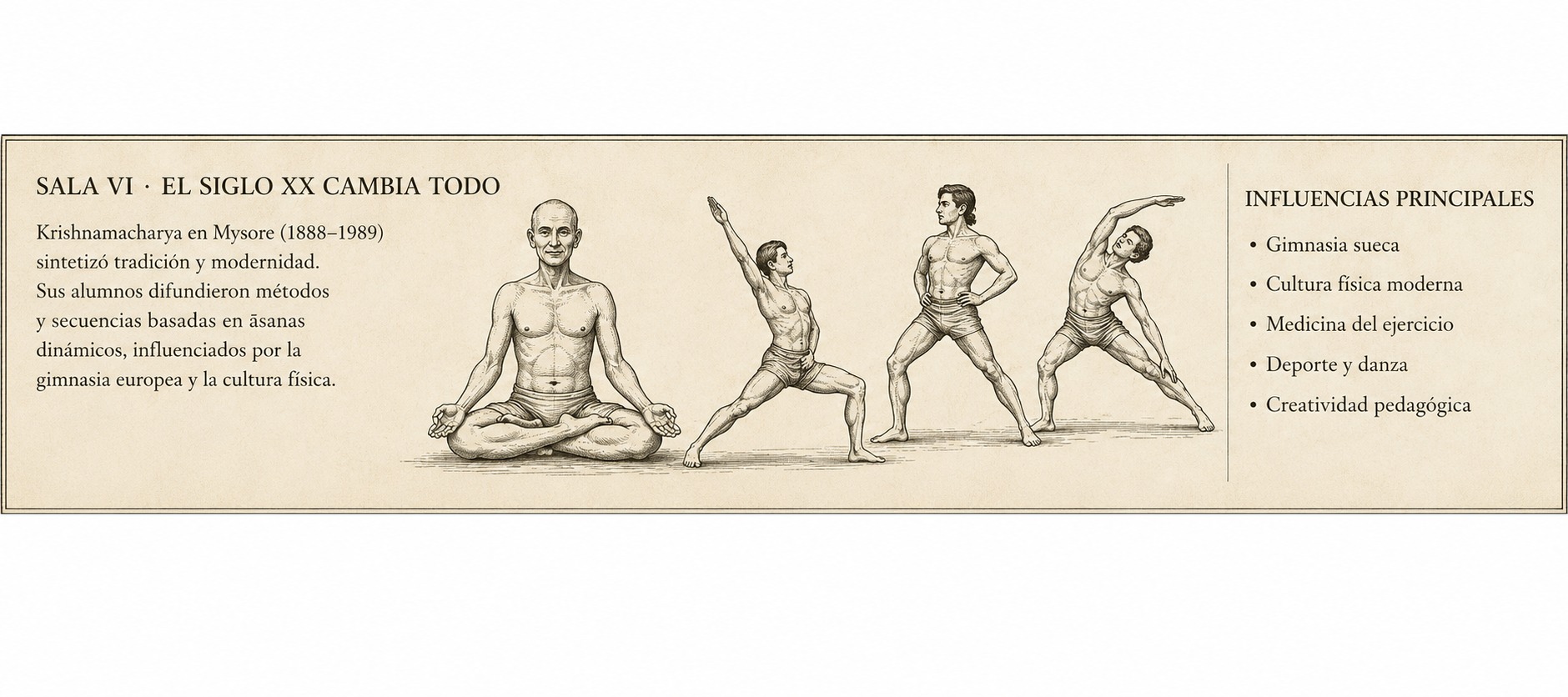
Krishnamacharya and Mysore
In the 1930s, Tirumalai Krishnamacharya taught a new pedagogy at the Mysore palace, one that synthesised the Sanskrit tradition, personal experimentation, and the physical culture of the time (gymnastics, weightlifting, even British military drills). Students of his school would include Pattabhi Jois, B.K.S. Iyengar and Indra Devi, each of whom carried that synthesis in a different direction.
Documented modern creationNorman Sjoman's account
Indologist Norman Sjoman documented a physical-gymnastics manuscript, the Sritattvanidhi, in the Mysore palace itself, containing postures that Krishnamacharya is thought to have incorporated and adapted into his method — one of the most widely cited clues to the crossover between yoga and modern gymnastics.
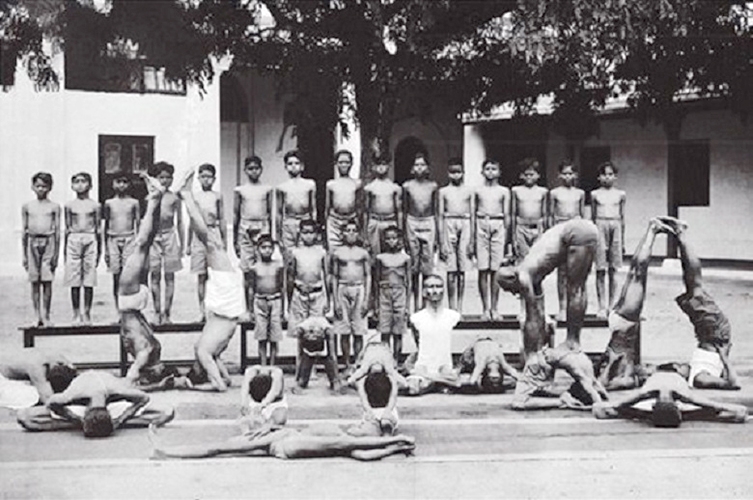
From here on we deliberately leave manuscripts and engravings behind: the shift to photography marks, visually too, the entry into modern yoga.
The class as a sequence
Transitions between postures, pacing and pedagogical progression take on an importance they never had before.
Not a forgery
A practice being modern doesn't make it illegitimate. It means it has a history.
Anatomy of a yoga class
A haṭha yoga class, 2026. How old is each of its parts, really? Let's follow, minute by minute, a fictional sixty-minute class — from the opening moment of awareness to the final relaxation.
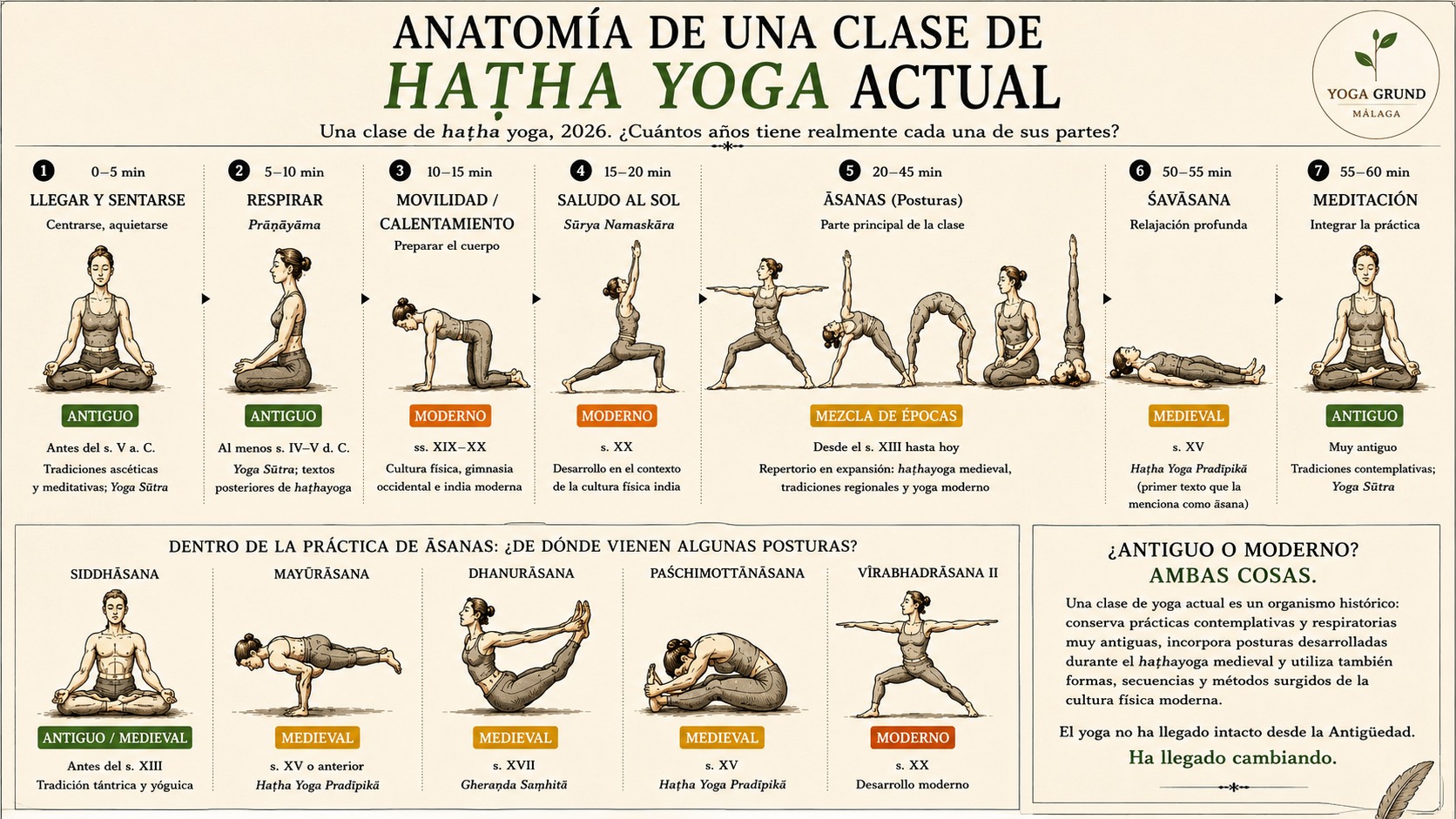
Both.
A yoga class today brings together very ancient contemplative and breathing practices, postures developed during medieval haṭha yoga, and forms, sequences and methods that are far more recent.
And it's only natural that this is so. Yoga has never been a static practice: throughout its history it has changed, adapted, and absorbed new knowledge about the body, movement and health. The fact that it keeps doing so today doesn't mean it's losing its essence.
What really is ancient
What's ancient isn't necessarily the sequence of postures we find in a yoga class today. What does have very old roots is the act of stopping, breathing, directing attention, and using the body as part of an inner practice. Breathing exercises, meditation, certain gestures and bodily seals, and the conscious pursuit of stillness also have a long history behind them.
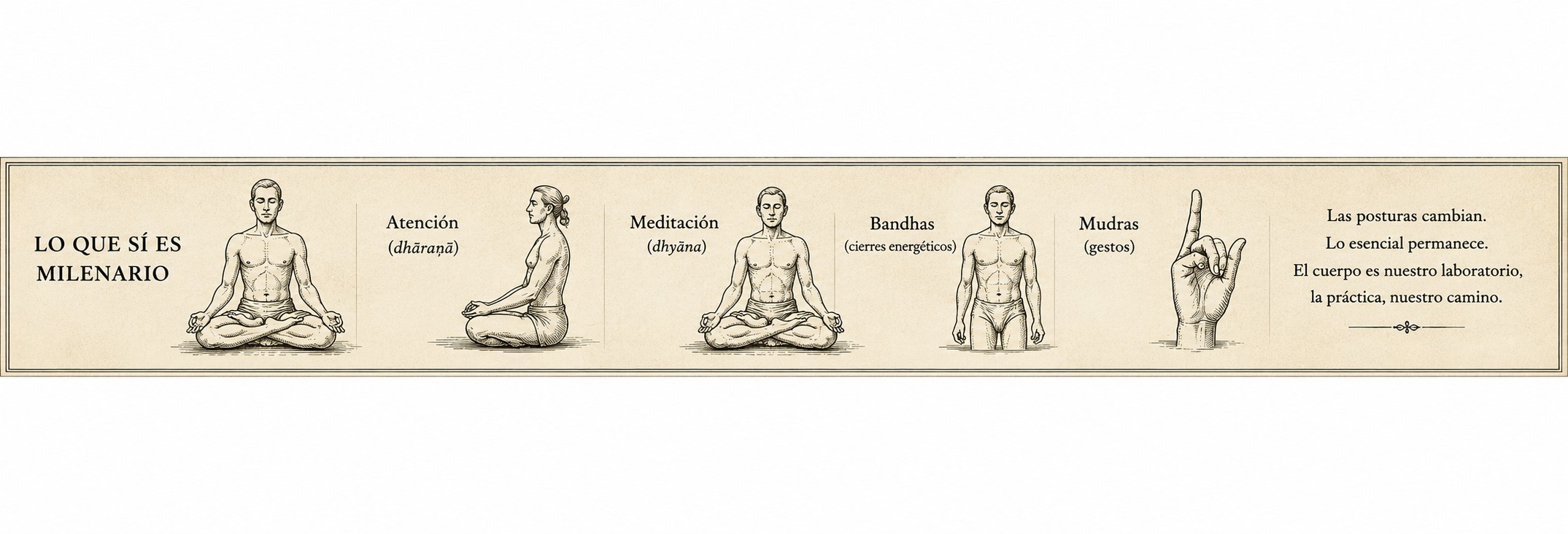
A less visible continuity
Postures have changed over the centuries: new forms appear, others disappear, names change, or forms get combined in new ways. That's why yoga's deepest continuity may not lie in repeating the exact same postures, but in something more fundamental: using the body, the breath and attention to transform our experience.
Seen this way, we can acknowledge that a large part of the postural yoga we practise today is modern, without cutting it off from the much older traditions it grew out of.
Main bibliography
James Mallinson and Mark Singleton
Roots of Yoga. Penguin Classics, 2017.
Mark Singleton
Yoga Body: The Origins of Modern Posture Practice. Oxford University Press, 2010.
Jason Birch
"The Meaning of Haṭha in Early Haṭhayoga." Journal of the American Oriental Society, 2011.
Svātmārāma
Haṭhapradīpikā, especially the chapter devoted to postures.
Gheraṇḍa Saṃhitā
Chapter II: a repertoire of thirty-two postures.
Norman E. Sjoman
The Yoga Tradition of the Mysore Palace. Abhinav Publications, 1996.