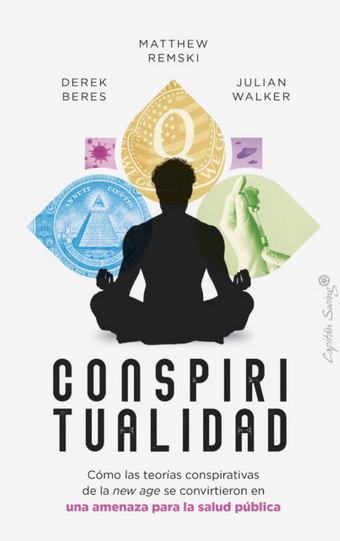
In 2024 I had the good fortune of translating Conspirituality (Capitán Swing) into Spanish, a book that put a name to something I'd been sensing for a while as I watched the yoga and wellness world.
The term "conspirituality" describes the surprising alliance between certain spiritual currents and conspiracy theories. At first glance they look like very different worlds, but they share a similar mental structure: the conviction that there's hidden knowledge reserved for a few "awakened" people, a permanent suspicion of institutions, and the idea that real wisdom always lies outside science, academia or the media.
Critical thinking in every direction
I don't think yoga necessarily leads to that kind of thinking. Not at all. But I do think this world, like any other, could use a virtue that's sometimes in short supply: critical thinking.
And when I say critical thinking, I mean applying it in every direction.
It seems perfectly legitimate to me to question a government's recommendations, a pharmaceutical company's conduct, or the conclusions of a particular scientific study. Science, after all, advances precisely because it constantly questions itself.
What's much harder for me to understand is when some people subject anything coming from an institution to relentless scrutiny... yet accept, with barely any reservations, the advice of a spiritual influencer, an internet healer, or someone claiming to have discovered a miracle cure for almost everything.
The book
Conspirituality: How New Age Conspiracy Theories Became a Public Health Threat began life as a podcast. In May 2020, in the middle of the pandemic, its three authors started documenting a troubling phenomenon: how a good number of yoga teachers and wellness influencers had begun spreading vaccine misinformation, theories about secret global plots, and every kind of disinformation. Instagram accounts that until then had shared green-smoothie recipes and Mary Oliver poems turned, almost overnight, into megaphones for conspiracy theories.
The book, published in English in 2023 (and in Spanish translation by Capitán Swing), is an extension of that work: a rigorous — but also empathetic and often funny — analysis of how a certain kind of spirituality and conspiratorial thinking ended up joining hands. It's not an attack on spirituality or on yoga: it's an invitation to look at them clearly, to recognise wellness scams, and to understand why well-meaning people sometimes end up defending dangerous ideas.
The term itself wasn't coined by the authors: researchers Charlotte Ward and David Voas first used it academically in 2011 to analyse the growing overlap between far-right conspiracism and the New Age longing for spiritual transformation.
The authors
All three are co-authors of the book and co-hosts of the Conspirituality podcast, and each brings a different angle to the subject:
Derek Beres is an author, journalist and media expert with years of experience writing about health, science and music. He trained in Religious Studies and spent many years teaching group fitness classes, where he developed a programme sitting at the intersection of music, neuroscience and movement.
Matthew Remski is a writer and researcher, and a survivor of a cult community himself. He's been writing critically about modern yoga culture since 2004; his book Practice and All Is Coming (2019) was the first systematic analysis of cult-like dynamics within the contemporary yoga world. He has also published Threads of Yoga, a rereading of Patañjali's Yoga Sūtras.
Julian Walker grew up between Zimbabwe and South Africa and has lived in Los Angeles since 1990. He's fascinated by the crossroads of yoga and meditation, psychology, science and culture. He has written extensively on cults and gurus, on spiritual bypassing, and on the "quantum pseudoscience" found in certain New Age circles, as well as on trauma, the body and neuroscience as applied to yoga practice.
An excerpt
On the difference between a healthy spirituality — one that makes room for doubt — and an immature spirituality that suppresses it. Use the arrows to turn the pages.
Spirituality — even in its shakier forms — answers deep human needs: meaning, purpose, community. When people gather in these spaces, they form bonds through rituals that generate flow states and open the door to neuroplastic changes in their habits, beliefs and priorities. That process can be beautiful and beneficial. But it can also sharpen personal vulnerabilities and take advantage of participants' good intentions.
A spirituality without solid grounding can end up turning into an obsession with transcendence that looks down on everyday life and the concrete concerns of the world. The intense bonds formed inside a closed group can produce an almost cult-like dependency and a systematic distrust of anything coming from "outside."
States of ritual ecstasy, which in the context of body-mind practices can have therapeutic effects, can also lead more vulnerable people to interpret the meaning of those states in delusional ways: "we are awakened," "we are indestructible," "we alone see the Truth." The history of spiritual excess is littered with wreckage: individuals and groups intoxicated by their own grandiosity. Indoctrinated people who become convinced they've reached some higher level of consciousness.
The paradox is that their arrogance grows just as fast as their distance from reality. The more fascinated a person becomes with their supposed inner power, the more their ability to act effectively in the world deteriorates.
Healthy spirituality, as we see it, should be balanced by an equally healthy scepticism. It shouldn't promise fast, absolute transformations, or revolve around narcissists with messianic delusions making outsized promises. It should welcome doubt and agnosticism as a natural part of learning and of being human.
Immature spirituality, by contrast, tries to root out the impulse to doubt in order to hold on to a pure, positive vision at all costs. The trouble is that repressed doubt has to go somewhere, and conspirituality is happy to point the way. To keep your spiritual life free of impurity, doubt has to be projected outward — onto institutions, governments, academic disciplines and the media.
Certain forms of spirituality can create a false sense of personal growth and empowerment. At the same time, conspiracy theories mimic a kind of healthy scepticism and a sense of control. Both spirituality and conspiracism ask their followers to "wake up" to a hidden reality. Both rest on a form of magical connection between ideas that puts apophenia — the tendency to see patterns where none exist — ahead of a critical, reflective attitude.
They bring to mind the classic obsessive detective standing at a corkboard, trying to make sense of chaos by connecting clippings, names and dates with red string, convinced it will all click into place eventually. When personal growth turns into an ever-deeper surrender to this kind of solipsism, the effect is the exact opposite of what's intended: followers become more closed-off and narcissistic, and end up defending beliefs that can become dangerous, both to themselves and to others.
— Yoga Grund Málaga
In the press
Two recent articles in the Spanish press covering the book and its authors, in case you want to keep pulling on the thread (both in Spanish):