In depth
Sivananda's 12 classic postures
A posture-by-posture tour through the classic Sivananda method sequence: technique, alignment, evidence-based benefits, and precautions.
Swami Sivananda
Swami Sivananda (1887–1963) was born Kuppuswami Iyer in Pattamadai, in southern India. Before taking the path of the monk, he trained and worked as a physician, including several years in British Malaya, where he cared for labourers working in very harsh conditions. That vocation for service stayed with him for the rest of his life — first as a doctor of the body, and later as a teacher of the soul.
In the early 1920s he left everything behind to become a wandering monk, eventually settling in Rishikesh on the banks of the Ganges, where he devoted himself fully to the practice of yoga and meditation. There, in 1936, he founded the Divine Life Society, and in 1948 the Yoga-Vedanta Forest Academy, one of the earliest models for yoga teacher training, later replicated all over the world.
Sivananda wrote close to 300 books and called his approach "the yoga of synthesis": an integration of the different classical paths — karma yoga, bhakti yoga, jñāna yoga and rāja yoga — rather than adherence to just one. In 1957, he sent one of his closest disciples, Swami Vishnudevananda, to the West, with an instruction as brief as it was decisive: "Go. People are waiting." That journey gave rise to what we know today as Sivananda yoga, organised around five principles and a sequence of twelve classic postures.

Swami Krishnananda and Swami Sivananda (right), c. 1945. Public domain — Wikimedia Commons.
Śīrṣāsana
SHEER-shah-sana
Headstand — the inversion posture par excellence. Requires preparation, focus and a solid base.
The name Śīrṣāsana is relatively modern. The posture itself, under other names, is much older: Hemacandra's Yogaśāstra (11th c.) already describes it as Duryodhanāsana. The Malla Purāṇa (13th c.) is the first text to mention it by the name Śīrṣāsana, though without describing it. As an inversion (Viparītakaraṇī), it's described in the Dattātreyayogaśāstra (13th c.), and as a mudrā in the Haṭha Yoga Pradīpikā (15th c.).
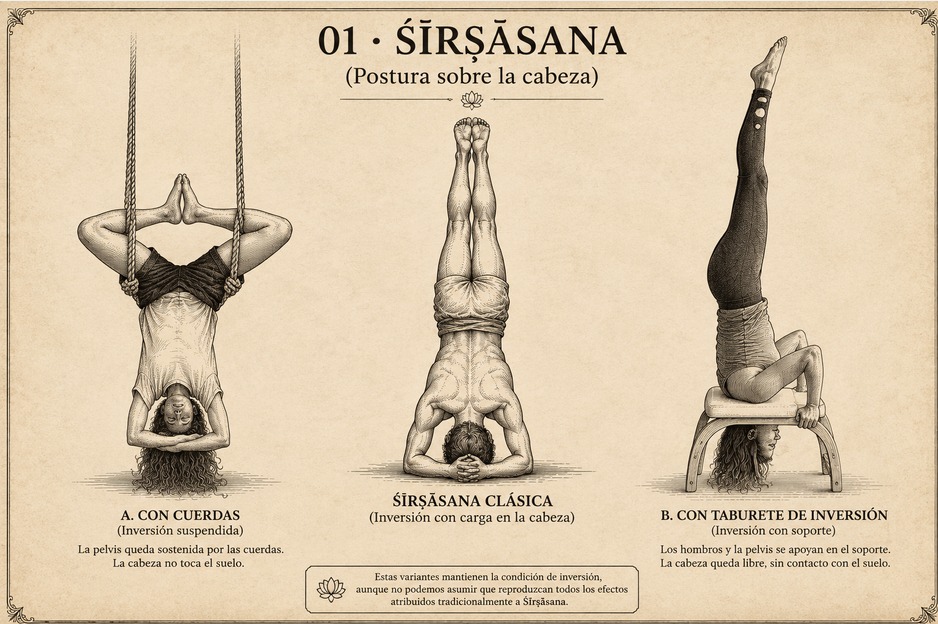
Technique
- Kneel and interlace your fingers. Rest your forearms on the floor, forming a triangle.
- Place the crown of your head on the floor, just in front of your interlaced hands. Your head forms the third point of the triangle.
- Lift your hips, walk your feet in toward your body, and straighten your legs.
- Bend one knee and draw that thigh toward your chest; then use the other leg to help. Lift both legs together, aiming for vertical.
- Engage your legs and core. Distribute your weight between your forearms, shoulders and head (not onto the head alone). Keep your breath smooth.
Alignment cues
- Shoulders away from the ears, shoulder blades engaged.
- Long neck, without collapsing weight onto it.
- Centre of the body over the base of support.
- Legs active, thighs rotated slightly inward.
What it works
- Shoulder and arm strength
- Scapular and core stability
- Balance and postural control
- Focus and concentration
In my classes
To avoid loading the neck, we usually work the inversion with ropes or an inversion stool instead of the classic Śīrṣāsana on the head.
Benefits
- Improved balance, strength and postural stability.[1][2]
- Improved flexibility and body composition.[1][2]
- Reduced stress and improved perceived wellbeing.[1][3]
- Inversion temporarily changes venous return and the position of the viscera; it may influence proprioception and autonomic control. Specific evidence is limited.
- Traditionally credited with effects on cerebral circulation, memory, mental clarity, and various organ and gland functions.
Contraindications and precautions
- Glaucoma, ocular hypertension and other eye conditions: inversions cause acute spikes in intraocular pressure.[4]
- Neck injuries, cervical disc herniation, severe arthrosis.
- Uncontrolled high blood pressure and significant heart disease.
- Pregnancy (especially from the 2nd trimester onward).
- Menstruation: there's no conclusive evidence to universally advise against it. Adapt based on the individual and their experience.
- Recurring headaches, migraine, dizziness: assess case by case.
- Traditionally advised against during colds, fever, or right after eating, among others. There's no solid evidence for this; it's a precautionary recommendation.
Selected bibliography
- Cramer, H. et al. (2017). Yoga for the prevention of chronic diseases: a systematic review and meta-analysis. Preventive Medicine, 101, 552–561.
- Ross, A. & Thomas, S. (2010). The health benefits of yoga and exercise: a review of comparison studies. Journal of Alternative and Complementary Medicine, 16(1), 3–12.
- Pascoe, M. C. et al. (2017). Yoga, mindfulness-based stress reduction and stress-related physiological measures: a meta-analysis. Psychoneuroendocrinology, 86, 152–168.
- Gupta, A. et al. (2015). Effect of head-down postures on intraocular pressure: a systematic review. Survey of Ophthalmology, 60(4), 443–453.
Sarvāṅgāsana
sar-vahn-GAH-sana
Shoulderstand — traditionally called "the queen of the āsanas." A full inversion supported on the shoulders and arms.
The name Sarvāṅgāsana is modern. The oldest documented form, a similar type of inversion under the name Viparīta Karaṇī, appears in the Śiva Saṃhitā (14th c.), and later in the Haṭha Yoga Pradīpikā (15th c.) and the Gheraṇḍa Saṃhitā (17th c.).
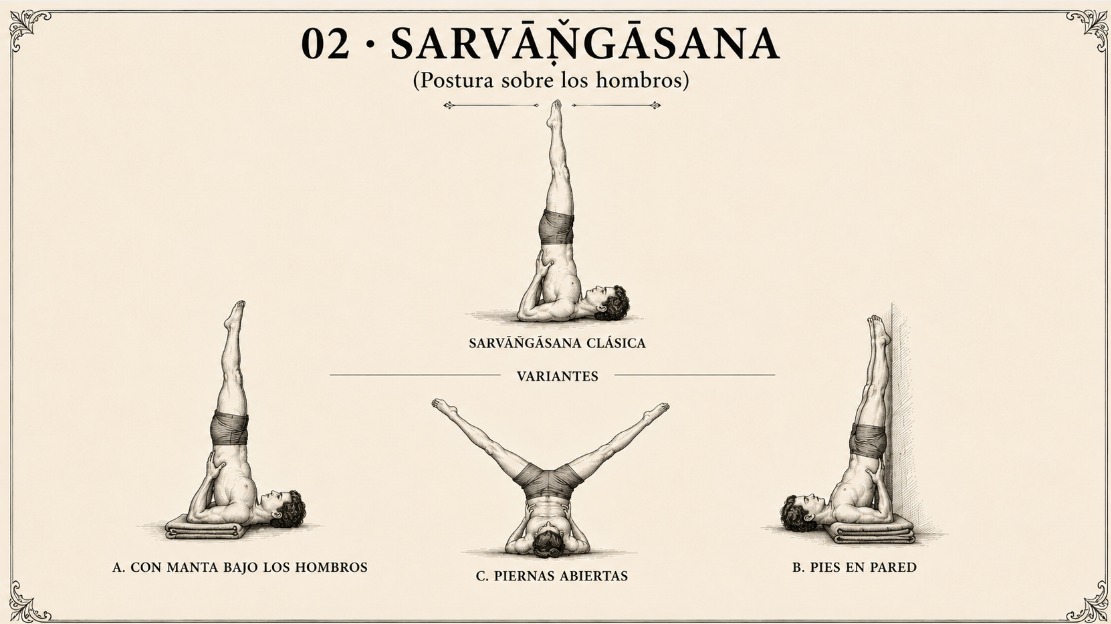
Technique
- Lie on your back, arms alongside your body, palms facing down.
- On an exhale, lift your legs to 90°, keeping your back and neck on the floor.
- Press your arms into the floor and lift your back off it, swinging your legs back over your head.
- Support your back with your hands, elbows shoulder-width apart, and lift your torso and legs toward vertical.
- Distribute your weight between your shoulders and arms, not on your head or neck. Keep your breath smooth.
Alignment cues
- Distribute weight through the shoulders and arms, not the head or neck.
- Head centred; don't turn the neck.
- Hands support the back, elbows shoulder-width apart.
What it works
- Postural control and inversion
- Stabilisation of the shoulder girdle and trunk
- Awareness and breath in an inverted position
A note on variants
All the variants preserve the inverted condition, though we can't assume they reproduce every effect traditionally attributed to Sarvāṅgāsana.
Benefits
- Traditionally credited with effects on the thyroid, circulation, the nervous system, constipation, sleep, and more. However, we don't have solid scientific evidence confirming these specific effects.[1][2]
Contraindications and precautions
- Cervical spine conditions or neck pain.
- Glaucoma and certain eye conditions.
- Uncontrolled high blood pressure.
- Avoid during pregnancy.
Selected bibliography
- Śiva Saṃhitā, ch. III, v. 78–80.
- Sivananda, Swami. 12 Basic Asanas. Yoga Publications Trust, 1960.
- Cramer, H. et al. Safety of Yoga: A Systematic Review of the Literature. International Journal of Yoga, 2013.
Halāsana
ha-LAH-sana
Plough posture. Combines inversion, hip flexion and spinal flexion. Usually follows Sarvāṅgāsana in the Sivananda sequence.
Unlike Śīrṣāsana and Sarvāṅgāsana, Halāsana doesn't appear to feature in the major medieval haṭha yoga texts. A recognisable plough-like posture is documented in the Śrītattvanidhi (19th c.) under the name Lāṅgalāsana — "lāṅgala" also means "plough." On our historical timeline, then, we place it as early modern, from the 19th century, rather than medieval: even though all three might look equally "ancient" to someone practising today, their documented history isn't the same.
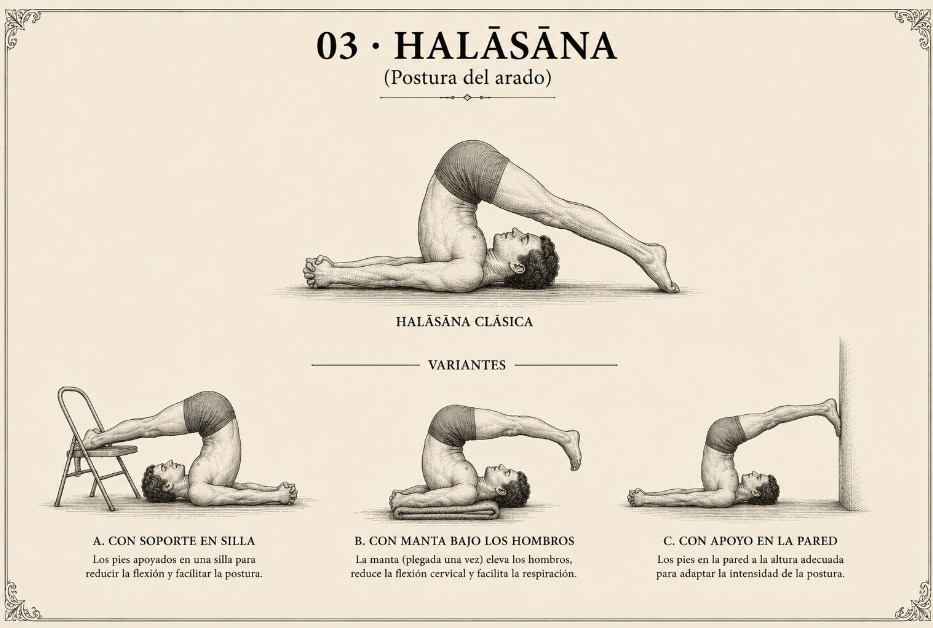
Technique
- Start lying on your back, usually coming from Sarvāṅgāsana in the sequence.
- Gradually bring the legs over the head, until the feet come close to or rest on the floor behind it.
- The knees can stay straight, but touching the floor shouldn't become the goal at any cost.
- Keep the head centred: don't turn the neck within the posture.
Alignment cues
- Head centred, no cervical rotation.
- Don't force the feet toward the floor if it means excessively increasing spinal flexion.
- Controlled entry and exit, without dropping the weight down.
What it works
- Posterior chain mobility (depending on execution)
- Trunk and pelvis control during entry and exit
- Tolerance to spinal flexion combined with inversion
Variants
The three shown here are deliberately practical: feet on a chair (reduces the demand of reaching the floor), a folded blanket under the shoulders (as in Sarvāṅgāsana, reduces cervical flexion), and feet resting against a wall at an adjustable height.
Benefits
- The posture actively places certain musculoskeletal structures through wide ranges of flexion. Turning this into "Halāsana improves flexibility" would require specific longitudinal evidence we don't have.
- There is some recent research on groups of forward-flexion postures (including Halāsana) and acute changes in autonomic variables, but it doesn't let us attribute the result specifically to this posture, or turn it into a clinical benefit.
- Traditionally credited with stimulating the thyroid, "massaging" the organs, improving digestion, rejuvenating the spine, and other systemic benefits common in yoga manuals. There's no solid scientific evidence backing these effects in isolation.
Contraindications and precautions
- Glaucoma or ocular hypertension: an experimental study measured Halāsana directly and found a significant rise in intraocular pressure, both in healthy people and in participants with glaucoma. Here the warning is backed by specific evidence, not just tradition.[1]
- Cervical conditions, neck pain, or neurological symptoms: adapt or skip the classic version.
- Osteoporosis or elevated vertebral fracture risk: Halāsana involves considerable spinal flexion, and exercise recommendations for osteoporosis generally treat extreme spinal flexion positions with caution.
Selected bibliography
- Śrītattvanidhi, 19th c. (Lāṅgalāsana).
- Experimental study on intraocular pressure during Halāsana, in healthy people and people with glaucoma.
Matsyāsana
mat-see-AH-sana
The fish posture — and why bridge tends to take its place in my classes instead.
Matsyāsana is described in the Gheraṇḍa Saṃhitā (2.21), from the 17th century. It traditionally follows Sarvāṅgāsana and Halāsana as a kind of counterpose: against the predominant flexion of the previous two, the fish moves the trunk into extension and opens the front of the body.
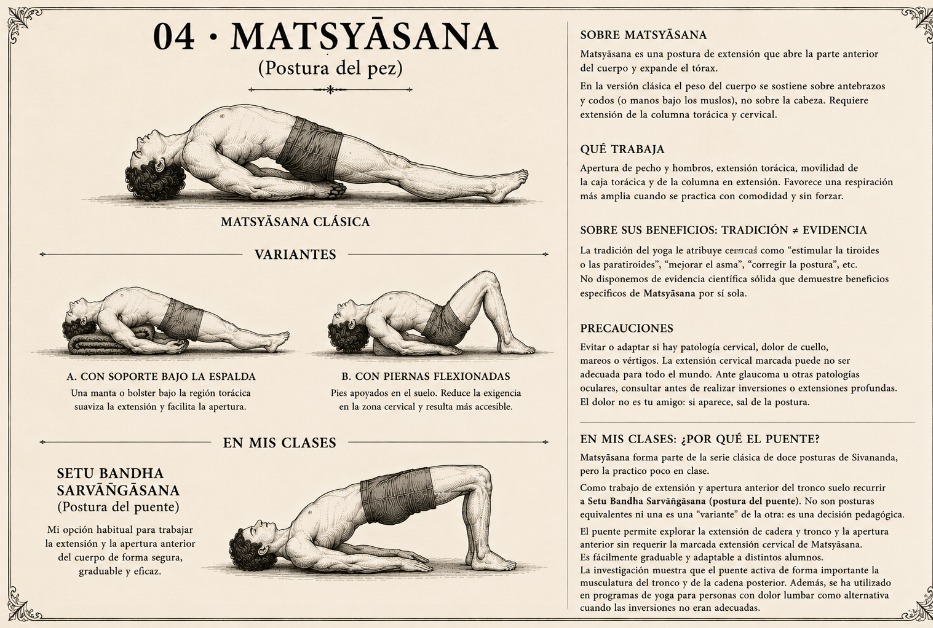
Matsyāsana — technique
- Lying on your back, lift the chest by actively pressing into your arms and forearms.
- Tip the head back, until the crown rests on the floor.
- The head shouldn't become the main point of support: hold the weight through the arms and forearms.
Matsyāsana — things to keep in mind
- Requires a fair amount of thoracic and cervical extension.
- Traditionally credited with specific effects on the thyroid, parathyroids, breathing or asthma that we can't consider scientifically proven in isolation.
From the classic series to my class
The fish is here because it's part of Sivananda's twelve basic postures. But studying a tradition is one thing, and turning it into a museum piece is another: the way I teach has also changed over the years.
Matsyāsana doesn't come up much in my classes these days. Instead, I usually work Setu Bandha Sarvāṅgāsana, the bridge posture — one that lets me explore extension and opening the front of the body in a way I find easier to grade and adapt, without demanding the same pronounced cervical extension as the fish. This isn't an "official" swap, and they're not equivalent postures: it's a teaching decision.
Bridge — technique
- Lying on your back, knees bent, feet placed close to the glutes.
- Gradually lift the pelvis, pressing through the feet and shoulder girdle.
- The neck stays relatively unloaded: don't turn the head while the pelvis is lifted.
Bridge — what it works
- Hip extension, with the glutes and hamstrings involved
- Trunk control
- Opening the front of the body, without the fish's cervical extension
Electromyographic research on bridge-type exercises confirms significant involvement of trunk and lower-limb musculature.[1]
Easy to grade
Pelvis height, foot position, hold time, dynamic or static repetitions, resting the pelvis on a block... Bridge allows for many more adjustable variables than the fish, which makes it easier to adapt to different students.
An interesting detail: some yoga protocols studied in people with lower back pain have used the bridge as an adaptation when inverted postures like Halāsana or Sarvāṅgāsana proved difficult. In a recent trial on mechanical low back pain, Setu Bandhāsana was included within a programme geared toward gentle extension and strengthening the glutes and hamstrings.[2] This doesn't prove the bridge alone treats low back pain — it was studied as part of a full programme — but it does support the biomechanical logic behind using it.
Benefits: without overreaching
- Bridge demands and trains hip extension and control of the posterior chain. We can describe which muscles are involved and how to grade the load.[1]
- "Bridge cures low back pain, improves circulation, stimulates the thyroid, and rejuvenates the spine." The fact that Setu Bandhāsana appears within programmes that have produced improvements doesn't prove those improvements came specifically from this posture.
Precautions
- If lower back pain, neck pain, radiating pain, tingling, or any clearly unpleasant sensation shows up, reduce the range or come out of the posture.
Selected bibliography
- Gheraṇḍa Saṃhitā, 2.21.
- Electromyographic study on bridge-type exercises and trunk/lower-limb muscle involvement.
- Clinical trial on mechanical low back pain with a gentle-extension and glute/hamstring-strengthening programme, including Setu Bandhāsana.
Paścimottānāsana
pash-chee-mo-tahn-AH-sana
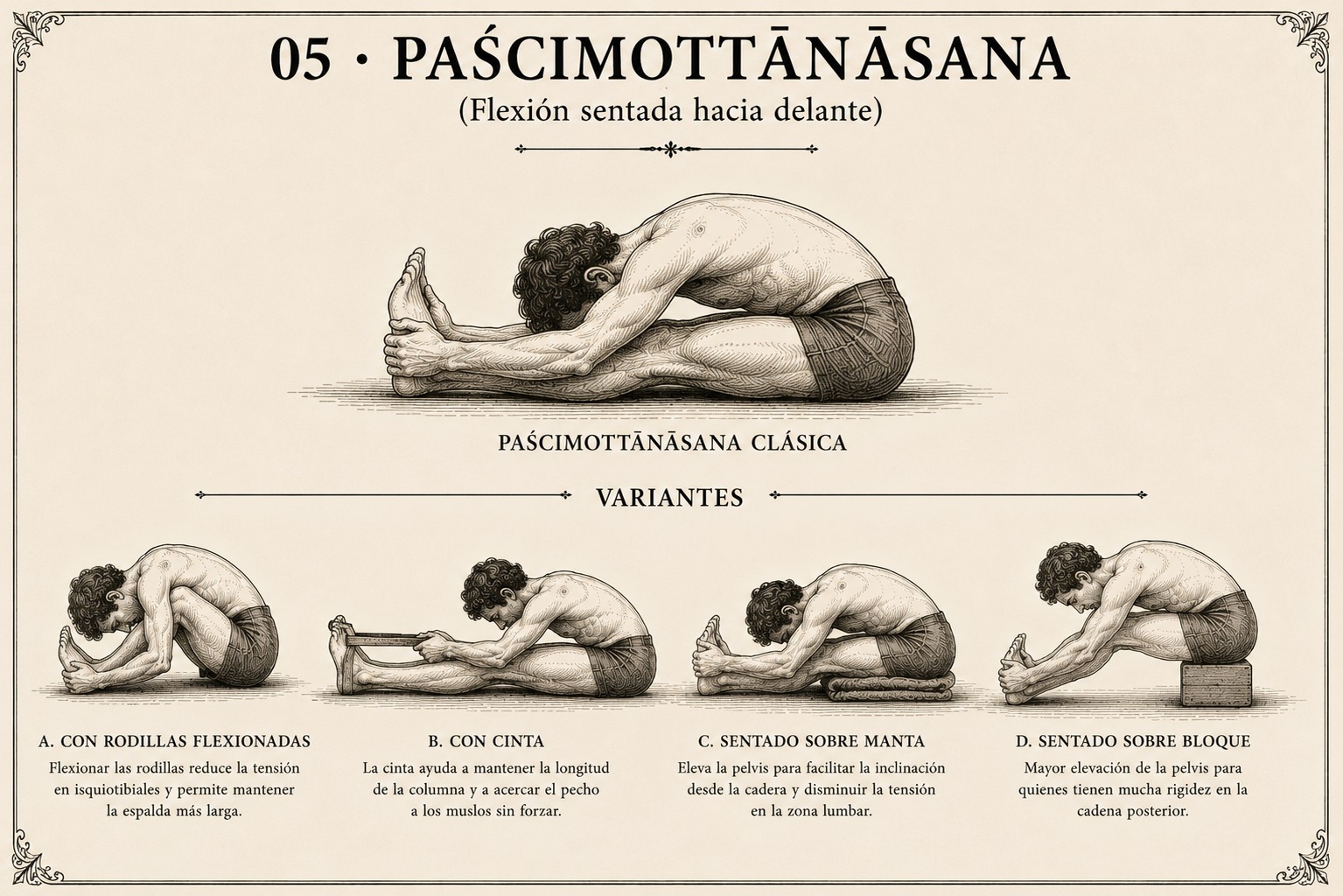
Seated forward fold. Belongs to premodern yoga.
Paścimottānāsana is described in the Haṭha Yoga Pradīpikā, composed roughly in the 15th century — one of the medieval postures that has carried through to contemporary practice.
Technique
- Sitting with legs extended, gradually tip the trunk forward until you find a comfortable range.
- The hands can rest on the legs, hold the feet, or use a strap.
- Touching the feet isn't the goal, and there's no need to force a perfectly straight back: some spinal flexion is a natural part of the movement.
What it works
- Lengthening of the posterior chain, with a demand especially noticeable in the hamstrings
- Hip and spine mobility
Bent knees: not cheating
Bending the knees changes the demand on the hamstrings and can make the posture far more accessible. It's not a "poorly done" version of Paścimottānāsana, or a second-tier posture.
The same goes for sitting on a blanket or a prop: it lifts the pelvis slightly and changes the relationship between the pelvis, legs and spine, which can make tipping forward easier. A strap isn't there for pulling the body harder, either: it extends the reach of the arms and lets you find a position you can hold without forcing anything.
Benefits
- Unlike what happens with many other āsanas, there's research on Paścimottānāsana as a standalone posture: a controlled trial with healthy young adults found that four weeks of regular practice produced significant improvements in hamstring flexibility and sit-and-reach test results.[2] Regular practice can improve hamstring flexibility and flexibility-test performance, at least in the short term in healthy young adults.
- Traditionally credited with numerous effects on digestion, the abdominal organs, metabolism or the nervous system. It has been used within studied interventions for irritable bowel syndrome, but as part of a broader practice combined with other āsanas and breathing techniques[3] — we don't have enough evidence to attribute those therapeutic benefits to Paścimottānāsana in isolation.
Precautions
- With an acute musculoskeletal injury, low back pain, or radiating symptoms, reduce, modify, or avoid the posture as needed.
- Tell the usual sensation of stretch apart from symptoms like pain, burning, tingling, or radiation down the leg. Not everything you feel behind the thigh or knee necessarily comes from a muscle that "needs stretching."
Selected bibliography
- Haṭha Yoga Pradīpikā, ch. I — historical source for Paścimottānāsana.
- Thapa, R. et al. Effect of 4 Weeks of Yogic-based Paschimottanasana Practice on Sit-and-Reach Test and Goniometer Measurements among Healthy Participants: A Randomized Controlled Trial. Advances in Mind-Body Medicine.
- Taneja, I. et al. Yogic versus conventional treatment in diarrhea-predominant irritable bowel syndrome: a randomized control study. Applied Psychophysiology and Biofeedback.
Bhujaṅgāsana
boo-jang-GAH-sana
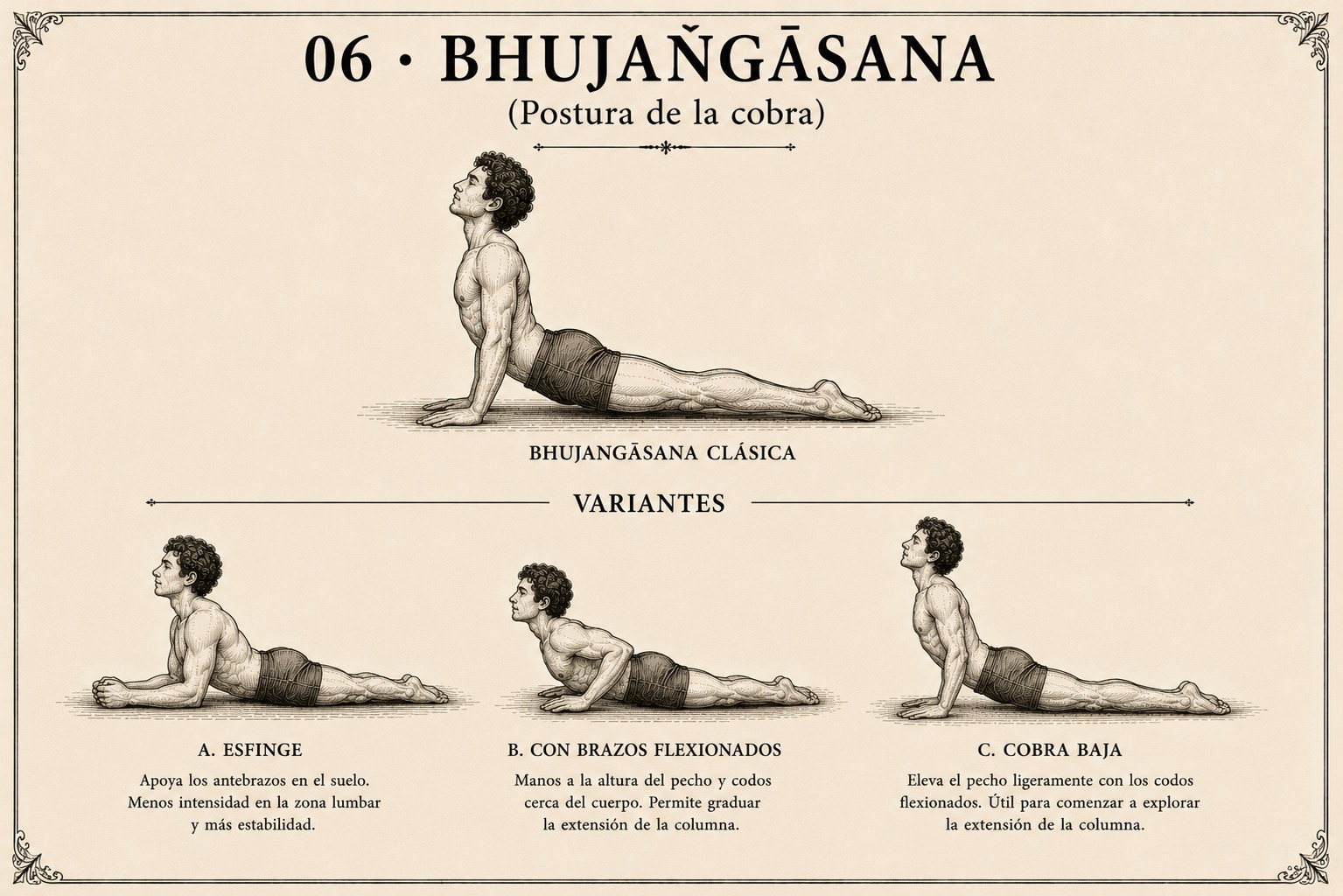
Cobra posture. Spinal extension from lying face down.
Its documented history is later, and it's worth distinguishing it from other extension postures that do appear in premodern sources. As a precaution, we're not assigning a specific "invention" date here: a posture's history doesn't necessarily start with the earliest written source we happen to have.
Technique
- Lying face down, place your hands roughly next to your chest.
- Gradually lift the chest through spinal extension. The arms can help, but they don't need to push the body up to the maximum possible height.
- Shoulders away from the ears; the neck naturally continues the line of the spine, without tipping the head back too far.
- The pelvis and legs stay resting on the floor.
What it works
- Spinal extension
- Scapular stabilisation
- Trunk extensor musculature
Benefits
- Bhujaṅgāsana demands active work from the spinal extensor muscles and from muscles involved in stabilising the shoulder girdle. Electromyographic studies of the Sun Salutation have found substantial activation of the spinal erectors, lower trapezius and latissimus dorsi, consistent with the mechanical demands of the posture.[1]
- Traditionally credited with strengthening the back, stimulating the abdominal organs and kidneys, improving digestion, or acting on endocrine functions. There's no solid clinical evidence attributing these effects specifically to Bhujaṅgāsana practised in isolation.
- It frequently appears in yoga programmes studied for low back pain, some with positive results — but these include other postures, breathing and relaxation, so we can't conclude the improvement comes from the cobra specifically.[2] Research on yoga for low back pain overall suggests modest benefits in certain people, but again, we're talking about full programmes, not a miracle posture.
Sphinx: less doesn't mean worse
Resting on the forearms and doing Salamba Bhujaṅgāsana (sphinx) reduces the degree of extension and allows the movement to be explored more gently. You can also do a low cobra, keeping the elbows bent and lifting the chest less.
How high you get doesn't measure the quality of Bhujaṅgāsana. A small, controlled, comfortable cobra can make a lot more sense than a deep extension achieved by pushing hard with the arms. There is specific clinical research on the sphinx and chronic low back pain, though its existence doesn't yet justify turning the posture into a universal treatment for back pain.[3]
Precautions
- Lumbar extension isn't harmful by definition, and there's no universal angle beyond which a cobra automatically becomes "wrong."
- If the posture causes low back pain, radiating pain, tingling, loss of strength, or any neurological symptom, reduce the range or come out of the posture.
- In people with a diagnosed spinal condition or persistent symptoms, whether extension work is appropriate depends on the specific problem. "I have a herniated disc" isn't, on its own, enough biomechanical information to decide which movements a person should or shouldn't do.
Selected bibliography
- Electromyographic research on the Sun Salutation: active musculature during Bhujaṅgāsana.
- Trials on yoga and low back pain that include Bhujaṅgāsana — evidence on the full intervention, not on the specific effects of the cobra.
- Specific clinical research on Salamba Bhujaṅgāsana (sphinx) and chronic low back pain.
Śalabhāsana
shah-lahb-HAH-sana
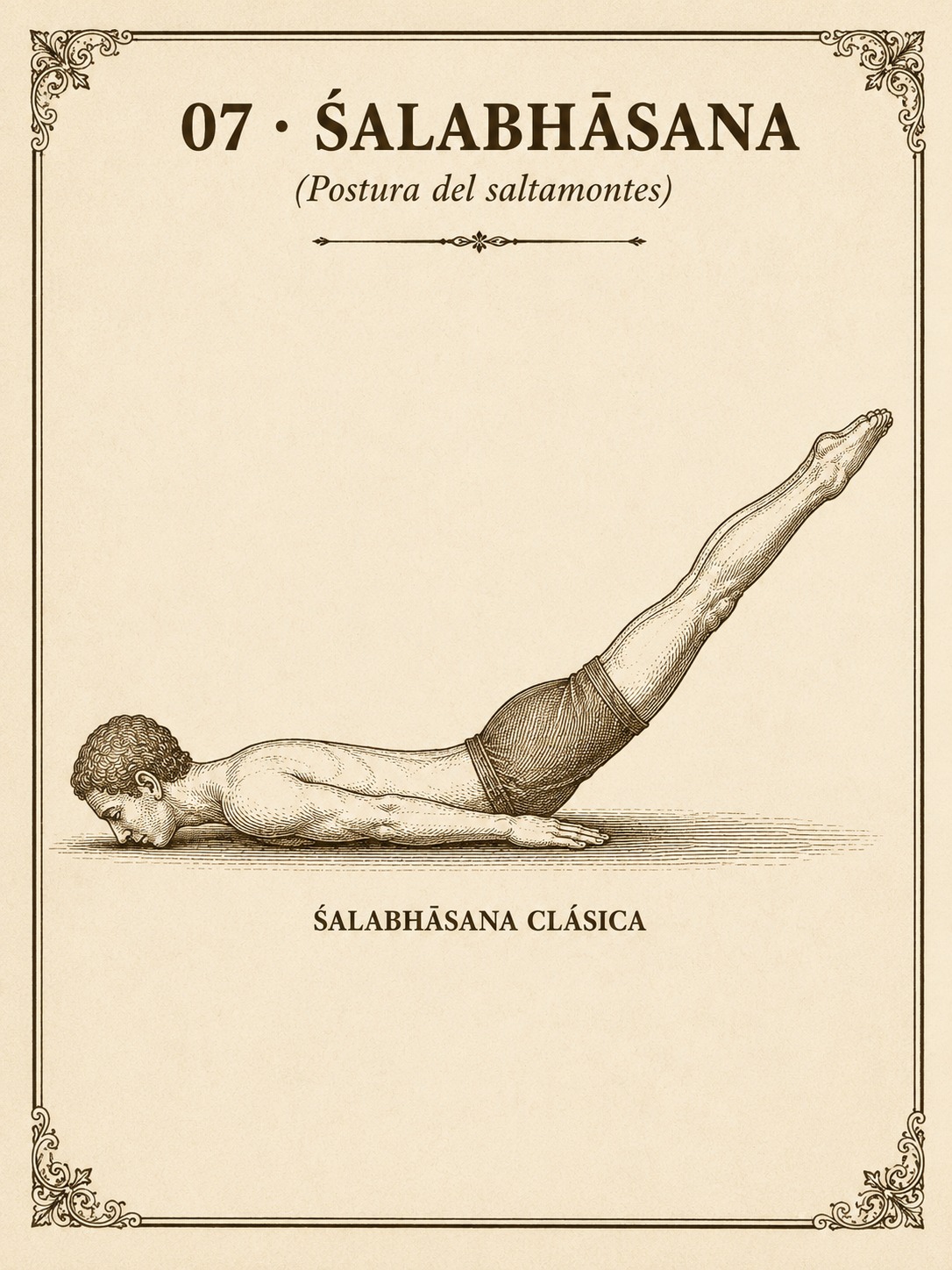
Locust posture. The only one in the series that works extension by lifting the legs, not the trunk.
The Gheraṇḍa Saṃhitā (2.39) includes it among its 32 āsanas, but describes it in a considerably more modest way than the version practised today: palms resting next to the chest, legs raised only "one elbow's length" off the floor. The form we practise today — arms alongside the body and a wider lift — was systematised in the 20th century, in manuals such as Swami Vishnudevananda's (1960) within the Sivananda tradition itself.
Technique
- Lie face down, chin resting on the floor — just the chin, without pressing the face into the mat.
- Place the arms alongside the body, palms in contact with the mat.
- On an exhale, lift both legs together, straight, without bending the knees.
- Height isn't the goal: a moderate, sustained, controlled lift is worth more than a sharp jerk upward.
- Keep the breath flowing, and lower the legs with the same control they went up with.
Alignment cues
- The chin stays down; the neck doesn't twist or turn.
- The palms gently press the floor to stabilise the trunk.
- The pelvis stays in contact with the floor: the legs lift from the glutes and back, not by throwing the hip.
- Legs active and together, without splaying on the way up.
What it works
- Spinal extensor musculature, especially lumbar
- Glutes and hamstrings (hip extension against gravity)
- Trunk control in extension
In my classes
I usually introduce it through half locust (ardha śalabhāsana): lifting one leg at a time, or with a variant in which one bent leg supports the other. Lifting both legs together demands quite a bit of lower back and hip strength; doing it one leg at a time offers the same work with a much more reasonable load.
Benefits
- Lifting the legs while lying face down is a classic posterior-chain strengthening exercise: electromyographic research on prone extension exercises shows substantial activation of the lumbar extensors and gluteus maximus. Śalabhāsana shares that same mechanics.[2]
- Traditionally credited with effects on digestion, "digestive fire," awakening subtle energies, and other systemic benefits common in classical manuals. There's no scientific evidence backing these specific effects.
Contraindications and precautions
- Acute low back pain or symptoms radiating down the leg (sciatica): reduce the height, work one leg at a time, or postpone the posture, as needed.
- Pregnancy: lying face down stops being a suitable position as the pregnancy progresses.
- If lifting both legs makes the lower back "catch" or hurt, half locust isn't a lesser version: it's the right dose.
Selected bibliography
- Gheraṇḍa Saṃhitā, 2.39 — historical source for Śalabhāsana.
- Electromyographic research on prone lumbar extension exercises and activation of the spinal extensors and gluteus maximus.
- Vishnudevananda, Swami. The Complete Illustrated Book of Yoga, 1960 — modern systematisation within the Sivananda tradition.
- Hernández, Danilo. Claves del yoga — reference for the half-locust variants.
Dhanurāsana
dah-noo-RAH-sana
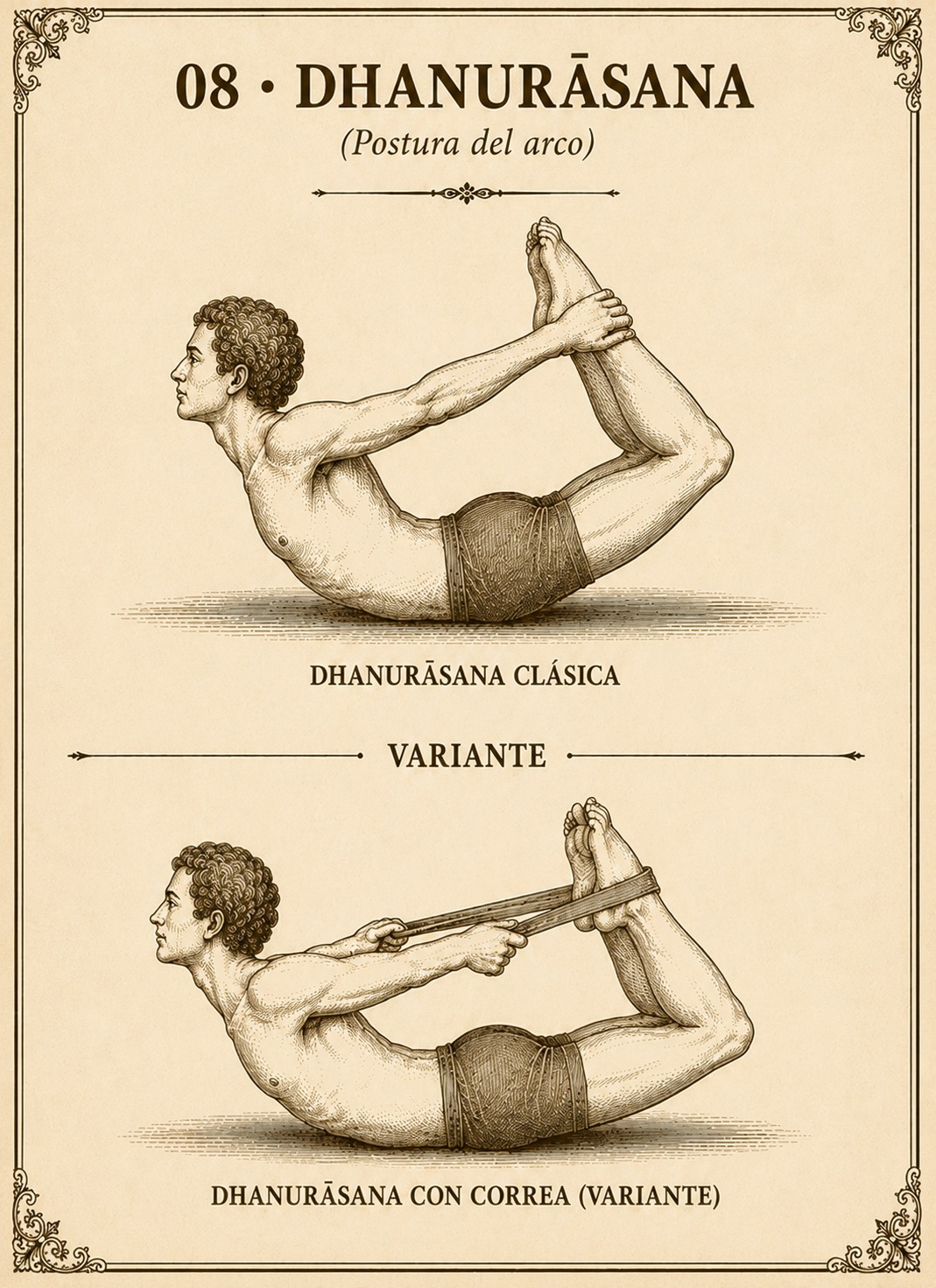
Bow posture. Lying face down, we hold the ankles and lift the body into the curve of a drawn bow.
This is one of the most interesting cases in the whole series. The name Dhanurāsana already appears in the Haṭha Yoga Pradīpikā (15th c., HYP 1.25) and the Gheraṇḍa Saṃhitā (17th c.), but the descriptions are ambiguous: several scholars (Hargreaves and Birch) argue that the text actually describes a seated posture, pulling the feet toward the ears like drawing a bow — closer to Ākarṇa Dhanurāsana than to the prone backbend. The version we call the "bow posture" today, the prone backbend, was established in the 20th century. Same name, two different postures.
Technique
- Lie face down, arms at your sides.
- Bend your knees and bring your heels toward your glutes.
- Hold your ankles with your hands (from the outside).
- On an inhale, push your ankles back and up: it's this push from the legs, more than the pull from the arms, that lifts the chest and thighs.
- Find the curve of the bow without chasing maximum height. Keep breathing, even though in this posture the breath will necessarily be shorter.
Alignment cues
- The lift comes from pushing the legs back, not pulling with the arms.
- Knees roughly hip-width apart, without letting them splay out too much.
- Long neck, gaze forward or slightly up, without compressing the back of the neck.
- Shoulders away from the ears.
What it works
- Spinal extension at its fullest expression in the series
- Opening the front of the body: chest, abdomen, hip flexors and quadriceps
- Back extensor musculature and glutes
A strap isn't giving up
If your hands don't reach your ankles — quite common, and mostly a matter of shoulder and quadriceps mobility — a strap around the ankles lets you do the posture with its full intent intact. It's not a watered-down version: it's the one that lets you work the bow without straining the shoulders or the lower back.
Benefits
- Dhanurāsana takes the spine into a broad extension and demands active work from the back extensor muscles, glutes and hamstrings, along with a marked stretch through the front of the body. We can confidently describe which structures are involved and why it's such a demanding posture.
- Traditionally credited with stimulating the abdominal organs, improving digestion, "massaging" the pancreas, or correcting posture. It sometimes appears in studied yoga programmes, but always as part of full sequences, so we can't attribute those effects to the posture in isolation.
Contraindications and precautions
- This is one of the most intense postures in the series. An acute lower back injury, radiating pain, or significant neck problems rule out the full version.
- Pregnancy: lying face down makes it unworkable for most of the pregnancy.
- Uncontrolled high blood pressure or recent abdominal surgery: assess case by case.
- If the lower back "catches" or you feel pinching, reduce the height, use a strap, or work gentler extension postures like Bhujaṅgāsana first.
Selected bibliography
- Haṭha Yoga Pradīpikā, 1.25 and Gheraṇḍa Saṃhitā, 2.18 — historical mentions of the name.
- Hargreaves, J. & Birch, J. "Dhanurāsana: Two Versions of Bow Pose." The Luminescent, 2017 — on the ambiguity between the seated version and the current one.
- Vishnudevananda, Swami. The Complete Illustrated Book of Yoga, 1960 — modern systematisation within the Sivananda tradition.
Ardha Matsyendrāsana
AR-dha mat-syen-DRAH-sana
Half spinal twist. The only twist in the series, and one of the few classic postures named after a teacher.
The seated twist appears in the Haṭha Yoga Pradīpikā (1.26–27, 15th c.) and later in the Gheraṇḍa Saṃhitā (2.22–23, 17th c.). Its name honours Matsyendra, "lord of the fish," one of the founding figures of haṭha yoga. What the classical texts describe is the full version (Paripūrṇa Matsyendrāsana); the "half" twist we usually practise is a later, more accessible adaptation.
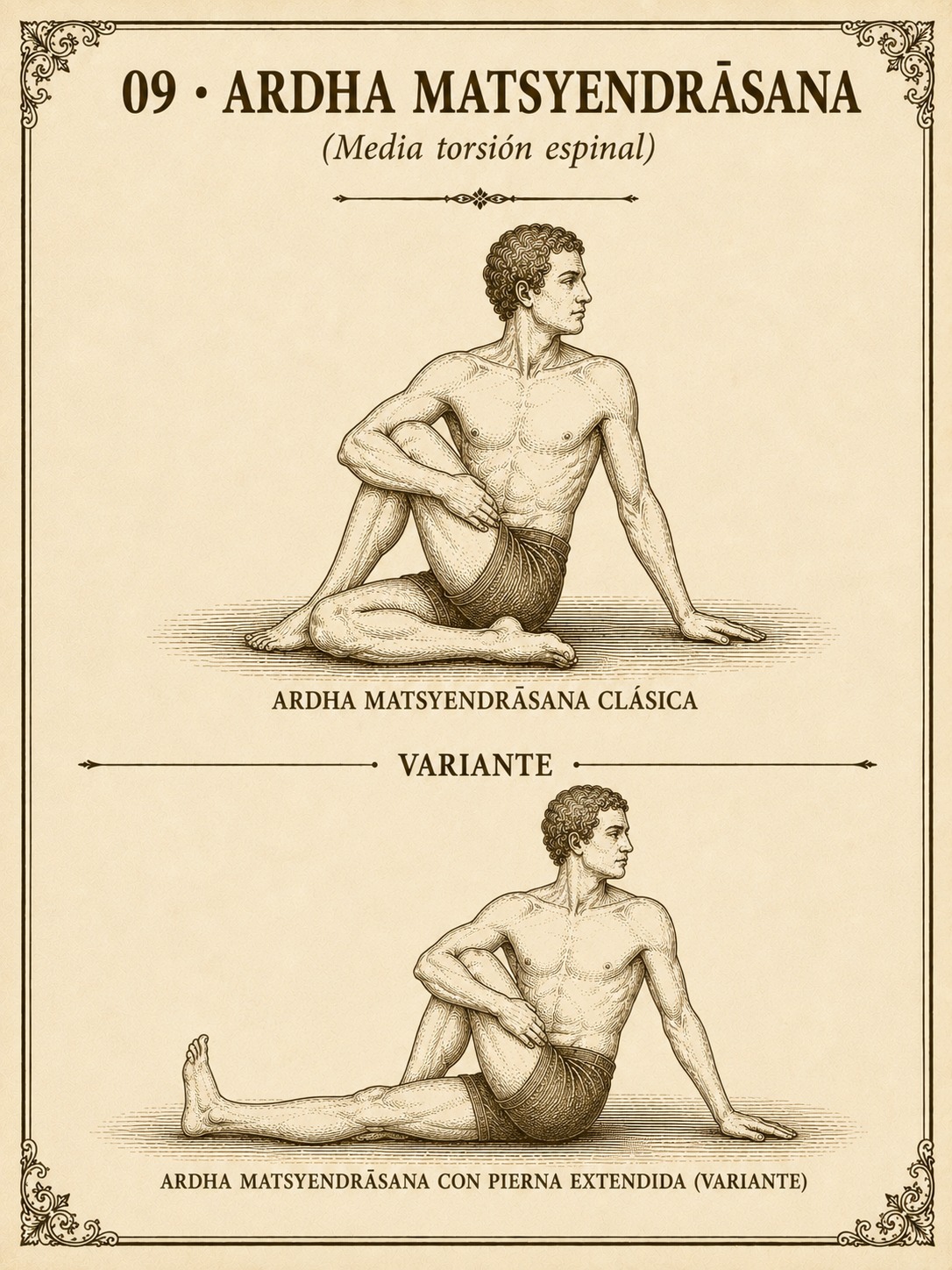
Technique
- Sitting, bend one leg and bring it toward the opposite glute (or keep it extended, in the more accessible variant).
- Cross the other leg over it, placing the foot outside the opposite thigh, knee pointing upward.
- Lengthen the spine upward before twisting: the twist starts from a long spine, not a rounded back.
- Rotate the trunk toward the side of the lifted knee, using the arm as support, not as a lever to force the twist.
- Always repeat on both sides.
Alignment cues
- Lengthen first, then twist: the rotation comes from a long axis.
- Both sit bones tend to stay on the floor; if one lifts a lot, extend the lower leg (variant).
- The rotation spreads through the whole spine, rather than concentrating in the neck.
- The back hand supports without pushing abruptly; the front arm follows along.
What it works
- Rotational mobility of the spine (mostly thoracic)
- Hip mobility
- Awareness of a long axis while rotating
An extended leg isn't doing less
Crossing both legs (the classic version) demands quite a bit of hip mobility. Leaving the lower leg extended (the variant shown in the plate) keeps the pelvis far more stable and lets you focus on rotating the spine, which is really what defines the posture. For most people, it's a cleaner way to work the twist.
Benefits
- It's a rotational mobility exercise for the spine and hips. Practising rotational range in a controlled way is simply training that mobility — describing that doesn't require appealing to anything esoteric.
- The Haṭha Yoga Pradīpikā claims outright that it "destroys numerous diseases." Tradition credits it with stimulating "digestive fire," massaging the abdominal organs, regulating the pancreas, or improving digestion. The idea that a twist "wrings out and detoxifies" the organs is a popular metaphor with no real physiological backing.
Contraindications and precautions
- Pregnancy: avoid deep, closed abdominal twists; more suitable open versions exist.
- Disc herniation, disc problems, or radiating pain: work the twist carefully and with limited range, or avoid it depending on the case.
- The twist shouldn't be "chased" by leveraging with the arm: a smaller, controlled rotation is preferable to a forced one.
Selected bibliography
- Haṭha Yoga Pradīpikā, 1.26–27 and Gheraṇḍa Saṃhitā, 2.22–23 — historical sources.
- Vishnudevananda, Swami. The Complete Illustrated Book of Yoga, 1960 — the twist as one of the twelve basic postures of the Sivananda series.
Kākāsana
kah-KAH-sana
Crow posture. The only arm-balance in the series.
Arm balances appear in later haṭha yoga texts: the Haṭha Ratnāvalī (17th c.) lists Bakāsana among its 84 āsanas, and the Śrītattvanidhi (19th c.) illustrates both Bakāsana and Kākāsana. A nuance that often gets confused: by tradition, Kākāsana (crow) is done with bent arms, and Bakāsana (crane) with straight arms. Within the Sivananda tradition, Vishnudevananda's manual (1960) describes precisely Kākāsana, the crow, with bent elbows.
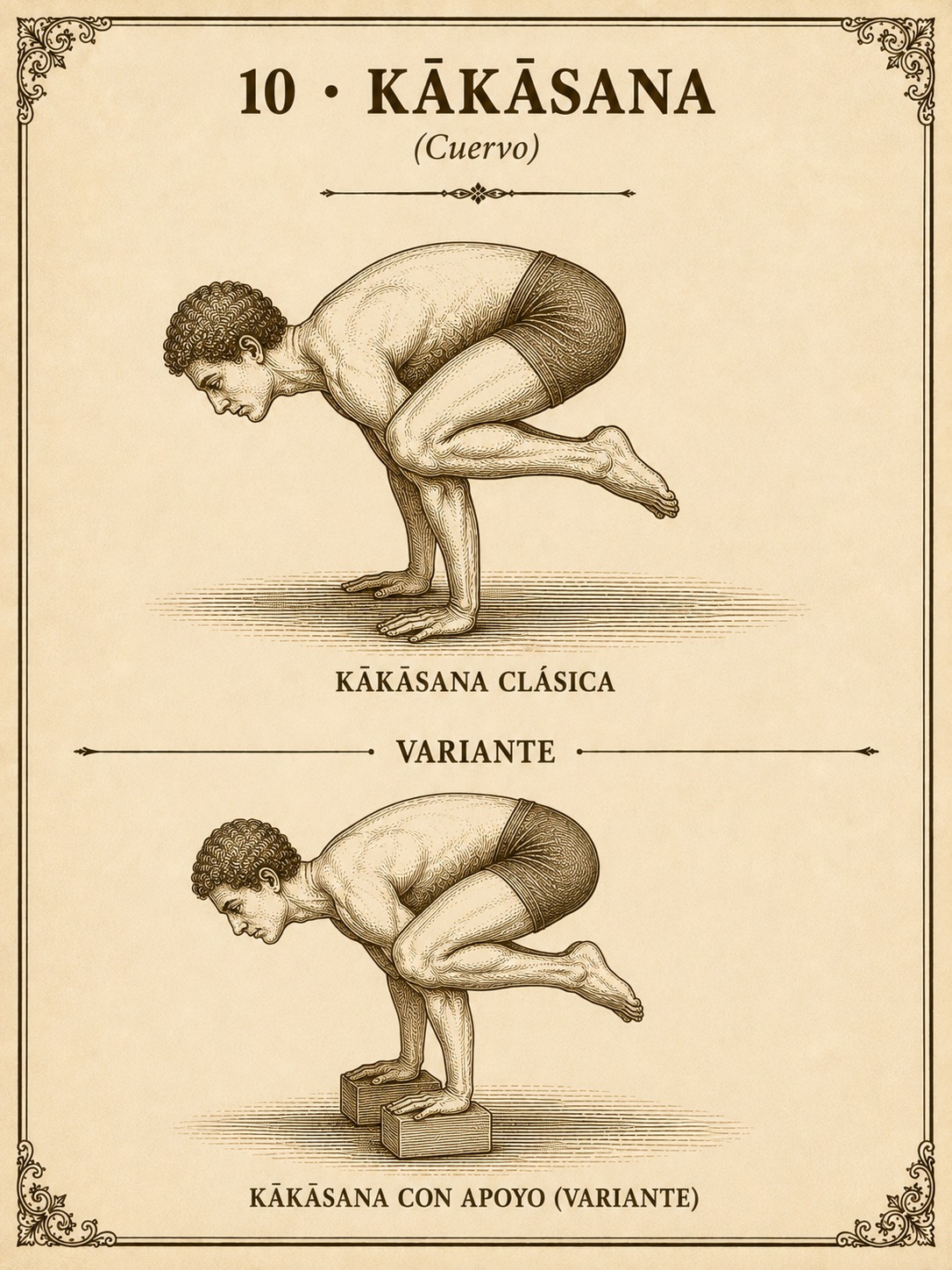
Technique
- Squat down and place your hands on the floor, shoulder-width apart, fingers spread wide.
- Bend the elbows (not fully straight) and rest the inner knees or shins on the upper arms.
- Gradually shift your weight forward, until your feet start to feel light.
- When the weight sits properly over the hands, the feet lift on their own. Look slightly forward, not down between your hands.
- To come out, shift the weight back and lower the feet with control.
Alignment cues
- Fingers spread wide and active: the hands "grip" the floor to stabilise.
- The gaze looks forward; looking down tends to tip you face-first.
- Balance is found by shifting the weight, not jumping into it.
- Rounding the upper back slightly helps lift the hips.
What it works
- Strength in the arms, wrists and shoulder girdle
- Core stability
- Balance, proprioception, and managing the fear of falling
In my classes
Fear of falling on your face is the main obstacle here, more than strength. It helps a lot to place a cushion or folded blanket in front, and to work the posture with the hands on blocks (as in the variant shown in the plate): raising the point of support reduces the sense of vertigo and makes it easier to lift the hips. It also helps to start by lifting one foot at a time.
Benefits
- It's a demanding upper-body strength exercise (wrists, arms, shoulders) combined with core stability and real balance work. That demand is obvious and describable without needing to reach for energetic explanations.
- Traditionally credited with activating the "solar plexus chakra," improving digestion, or increasing prāṇa flow. These are symbolic readings, without specific physiological backing.
Contraindications and precautions
- Wrist injury or pain, carpal tunnel syndrome: the load on the wrists is considerable.
- Advanced pregnancy, a significant hernia, or recent surgery: assess and, generally, avoid.
- Always guard against a forward fall with a cushion or blanket.
- If the wrists take too much load, reduce the hold time, work on blocks, or substitute with strength prep that doesn't lift the feet off the floor.
Selected bibliography
- Haṭha Ratnāvalī (17th c.) and Śrītattvanidhi (19th c.) — historical mentions of Bakāsana and Kākāsana.
- Vishnudevananda, Swami. The Complete Illustrated Book of Yoga, 1960 — describes Kākāsana (bent arms) within the Sivananda tradition.
Pāda Hastāsana
PAH-da has-TAH-sana · also Uttānāsana
Standing forward fold. The standing version of the fold we already saw seated in Paścimottānāsana.
The same pattern as Dhanurāsana repeats here: the name Uttānāsana appears in the Śrītattvanidhi (19th c.), but it described a completely different posture — lying on the back, elbows toward the knees, hands behind the neck — not a standing fold. The standing forward fold we practise today is a modern, 20th-century posture, described by Krishnamacharya (1934) and later spread by his students. "Pāda Hastāsana" (hand to foot) is the variant in which the hands go under the feet or toward the ankles.
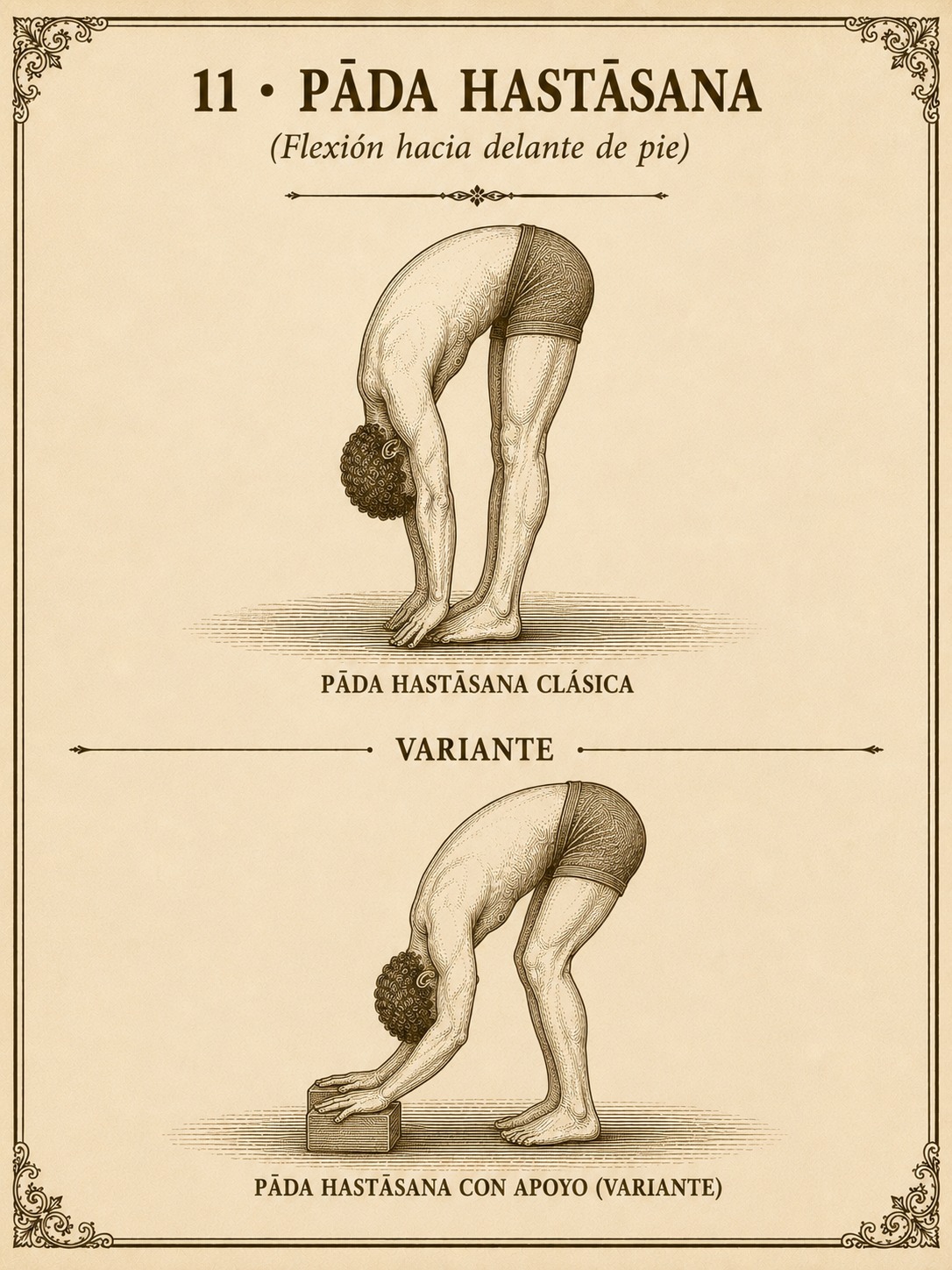
Technique
- Standing, with your feet roughly hip-width apart, tip your trunk forward, folding from the hip.
- Let the head and neck drop, relaxed. The hands go toward the floor, the ankles, or under the feet, depending on each person's mobility.
- There's no need to lock the knees: a slight bend protects the lower back and hamstrings.
- The weight shifts toward the front of the foot, without letting the hips drift too far back.
Alignment cues
- The fold comes from the hip, not from "rounding" the lower back to go further down.
- Slightly bent knees if the hamstrings pull: that's not cheating.
- Neck and shoulders loose; the head hangs without tension.
- Touching the floor isn't the goal.
What it works
- Lengthening of the posterior chain: hamstrings, glutes and back
- Hip mobility in flexion
- Releasing and relaxing the neck and shoulders
The same idea as the seated fold
Exactly what we said about Paścimottānāsana applies here too: bent knees aren't cheating, and a block under the hands (as in the variant in the plate) isn't a lesser version. Raising the floor up to your hands lets you keep the back longer and work hip flexion without straining the hamstrings.
Benefits
- As a forward fold, it places the posterior chain under lengthening, with a clear demand on the hamstrings — just like its seated version. Regular practice of forward folds is associated with improved hamstring flexibility.[2]
- Traditionally credited with "calming the nervous system," improving digestion, or increasing blood flow to the brain. The sense of calm after a forward fold is real and pleasant, but turning that into specific physiological effects goes further than the evidence allows us to claim.
Contraindications and precautions
- Acute low back pain or disc herniation: bend the knees, don't force the descent, or work the version with hands on the wall or on a block.
- Blood pressure issues or dizziness: come up slowly when exiting, to avoid dizziness from the sudden change in head position.
- Tell the stretch of the hamstrings apart from pain radiating down the leg; if the latter shows up, reduce or come out of the posture.
Selected bibliography
- Śrītattvanidhi (19th c.) — where "Uttānāsana" names a different posture from today's.
- Krishnamacharya, T. Yoga Makaranda, 1934 — modern description of the standing fold.
- Thapa, R. et al. — trial on forward-fold practice and hamstring flexibility (see also Paścimottānāsana).
Trikoṇāsana
tri-ko-NAH-sana
Triangle posture. Closes the series: the only standing, lateral, wide-opening posture.
The triangle is one of the most clearly modern postures in the whole series. It doesn't appear in the Haṭha Yoga Pradīpikā or the Gheraṇḍa Saṃhitā: the medieval texts focus on seated postures, with very few standing ones. Trikoṇāsana is first described in the 20th century, in the teaching of Krishnamacharya (Yoga Makaranda, 1934) and his students. Krishnamacharya, seeking to revitalise and popularise yoga, is thought to have drawn in part on Western physical culture of the time (gymnastics and other bodily disciplines). A fitting reminder to close the series: "classic" doesn't always mean "ancient."
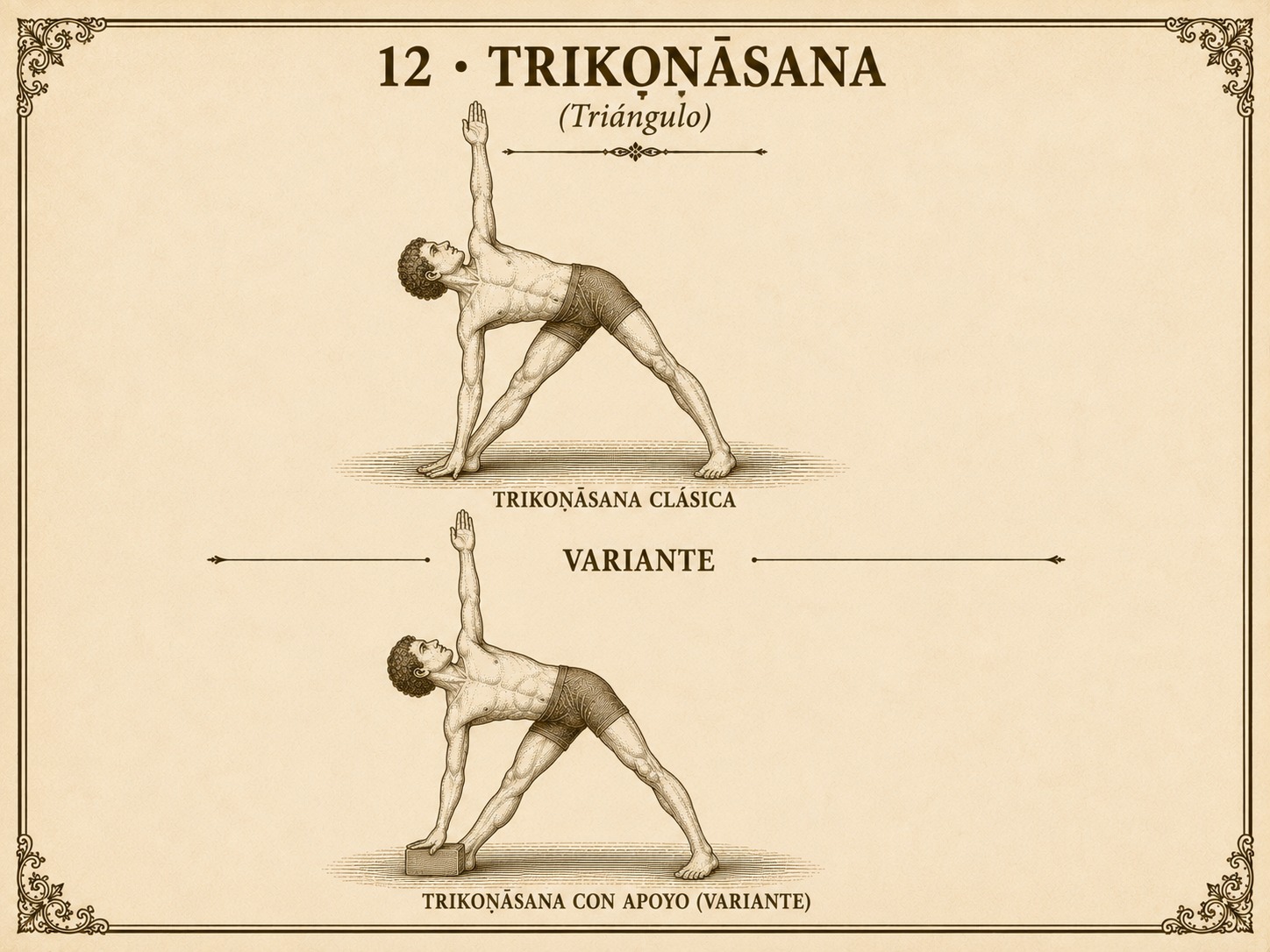
Technique
- Standing, step the feet apart roughly one leg-length. Turn one foot out 90° and the other slightly in.
- Extend the arms out to the sides, at shoulder height.
- Lengthen the trunk toward the turned foot and, from there, lower that hand toward the shin, ankle or a block — without collapsing that side of the body.
- The other arm reaches toward the ceiling, forming a line. The gaze can go toward the top hand, or stay forward if the neck complains.
- Always work both sides.
Alignment cues
- The movement is lateral: imagine tipping between two panes of glass, without leaning forward.
- Don't chase lowering the hand: only go down as far as that side of the body stays long.
- The legs are active; the knees aren't locked with tension.
- The chest opens toward the side, rather than facing the floor.
What it works
- Opening and lengthening the side body (lateral trunk muscles)
- Hip mobility and stretch of the hamstrings and adductors
- Leg stability and strength
A block lengthens the posture
Bringing the hand all the way to the floor forces most people to shorten that side of the body or rotate the chest downward. Resting the hand on a block (as in the variant in the plate) brings the floor up to you and lets you keep the trunk long and the chest open — which is exactly what defines the triangle. It's not a lesser version: for many bodies, it's the more correct one.
Benefits
- It's a leg strength and mobility exercise, combined with lateral trunk opening and a hip stretch. There is specific biomechanical research on Trikoṇāsana that has analysed the joint loads of the posture, making it one of the few āsanas with dedicated research of its own.[2]
- Traditionally credited with improving digestion, stimulating the abdominal organs, or "balancing energies." As with the rest of the series, these are traditional readings without specific physiological backing.
Contraindications and precautions
- Neck problems: don't turn the head to look at the top hand; keep the gaze forward.
- Blood pressure issues or dizziness, hip or knee injury: adapt the range and use a block.
- If the side of the body "closes off" or low back pain shows up, raise the hand's point of contact instead of forcing it lower.
Selected bibliography
- Krishnamacharya, T. Yoga Makaranda, 1934 — first modern description of the triangle.
- Biomechanical research on joint loads in Trikoṇāsana (e.g., studies on alignment and posture safety).
- Vishnudevananda, Swami. The Complete Illustrated Book of Yoga, 1960 — the triangle as the closing posture of the twelve basics in the Sivananda tradition.