In depth
Is there an authentic yoga?
On the myth of an ancient, unchanging yoga — and why that's nothing to worry about.
If you've been practising yoga for a while, chances are you've heard that the postures we do today are thousands of years old. It's a very widespread idea. It's also, at least in part, a myth.
For a long time I imagined that the āsana sequences we practise today descended directly from the ancient yogis of India. But when I read Mark Singleton's Yoga Body, I discovered a rather more complex story... and, in my opinion, a far more fascinating one. Most of the postural yoga practised in the West today is surprisingly recent. Many of its postures and sequences began taking shape in the early decades of the 20th century, in a context where Indian traditions, European gymnastics, physical culture, Indian nationalism and new ideas about health and physical education were all in dialogue with one another.
Even the famous sun salutation (Sūrya Namaskāra), which many people imagine as an ancient ritual, doesn't appear described in the classical yoga texts. Its modern form began to spread in the 1920s thanks to the Raja of Aundh, Bhawanrao Pant Pratinidhi, who promoted it as a physical exercise method accessible to the whole population. It was later taken up and transformed by teachers such as Krishnamacharya and, afterwards, Pattabhi Jois, B.K.S. Iyengar and many others.
Does that mean modern yoga is "fake"? Not necessarily. Though it's worth not confusing evolution with whim. The fact that yoga has changed throughout history doesn't mean that any activity we tack the word "yoga" onto automatically becomes part of that tradition. Beer yoga, goat yoga or paddleboard yoga might be a lot of fun, but it's hard to see what they actually have to do with the classical goals of the practice.
Either way, yoga has always been a living tradition. It has changed shape again and again, in dialogue with the cultures and needs of each era. And it's likely that the same thing is happening today. Maybe we shouldn't worry so much about whether a posture is two hundred or two thousand years old. Perhaps it would be more interesting to ask what it offers the person practising it. Today we know a lot more about anatomy, pain, movement and biomechanics than we did a century ago. It would be strange to ignore all that knowledge just because a particular way of doing a posture happens to be older. Traditions survive precisely because they're able to adapt without losing what makes them recognisable.
Maybe the real tradition of yoga isn't about preserving every posture exactly as it was, but about keeping alive the same question that has travelled with it for centuries: how can we live with more attention, more freedom, and less suffering?
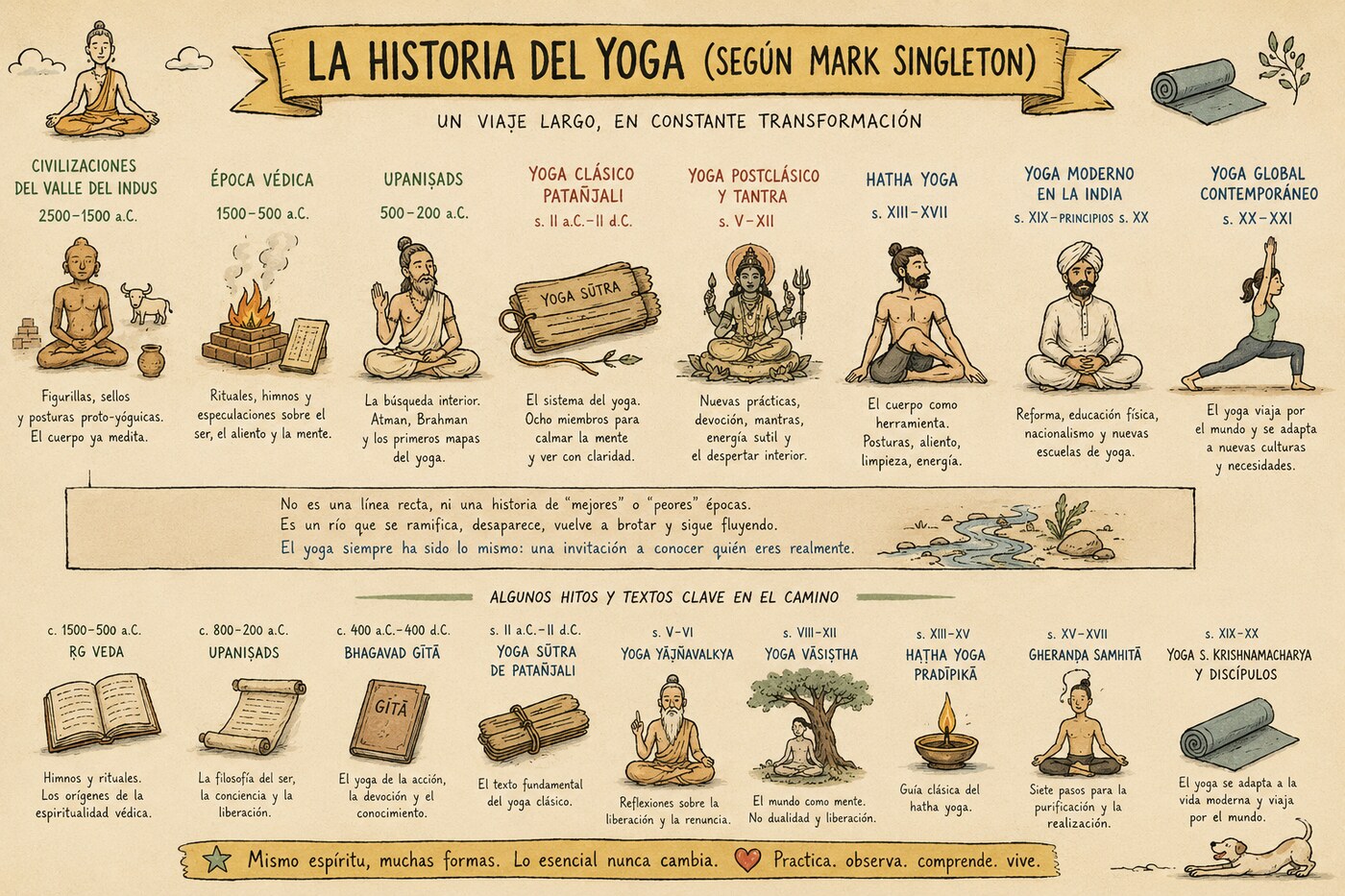
The history of yoga, according to Mark Singleton — a branching river, not a straight line. (Infographic in Spanish.)
According to Mark Singleton
The history of yoga — a long journey, in constant transformation
Indus Valley civilisations2500–1500 BCE
Figurines, seals and proto-yogic postures. The body is already meditating.
Vedic period1500–500 BCE
Rituals, hymns and speculation on the self, the breath and the mind.
Upaniṣads500–200 BCE
The inward search. Ātman, Brahman, and the first maps of yoga.
Patañjali's classical yoga2nd c. BCE – 2nd c. CE
The system of yoga. Eight limbs to calm the mind and see clearly.
Postclassical yoga and Tantra5th–12th c.
New practices, devotion, mantras, subtle energy and inner awakening.
Haṭha Yoga13th–17th c.
The body as a tool. Postures, breath, cleansing, energy.
Modern yoga in India19th c. – early 20th c.
Reform, physical education, nationalism, and new schools of yoga.
Contemporary global yoga20th–21st c.
Yoga travels the world and adapts to new cultures and needs.
It's not a straight line, nor a story of "better" or "worse" eras.
It's a river that branches, disappears, resurfaces and keeps flowing.
Yoga has always been the same thing at heart: an invitation to know who you really are.
To go deeper
The Museum of āsana
If you want the full breakdown, posture by posture, with illustrated plates, real historical documents and a timeline for each classical text, visit the Museum of āsana: a tour dedicated entirely to the concrete history of yoga postures.
Enter the museum →— Yoga Grund Málaga