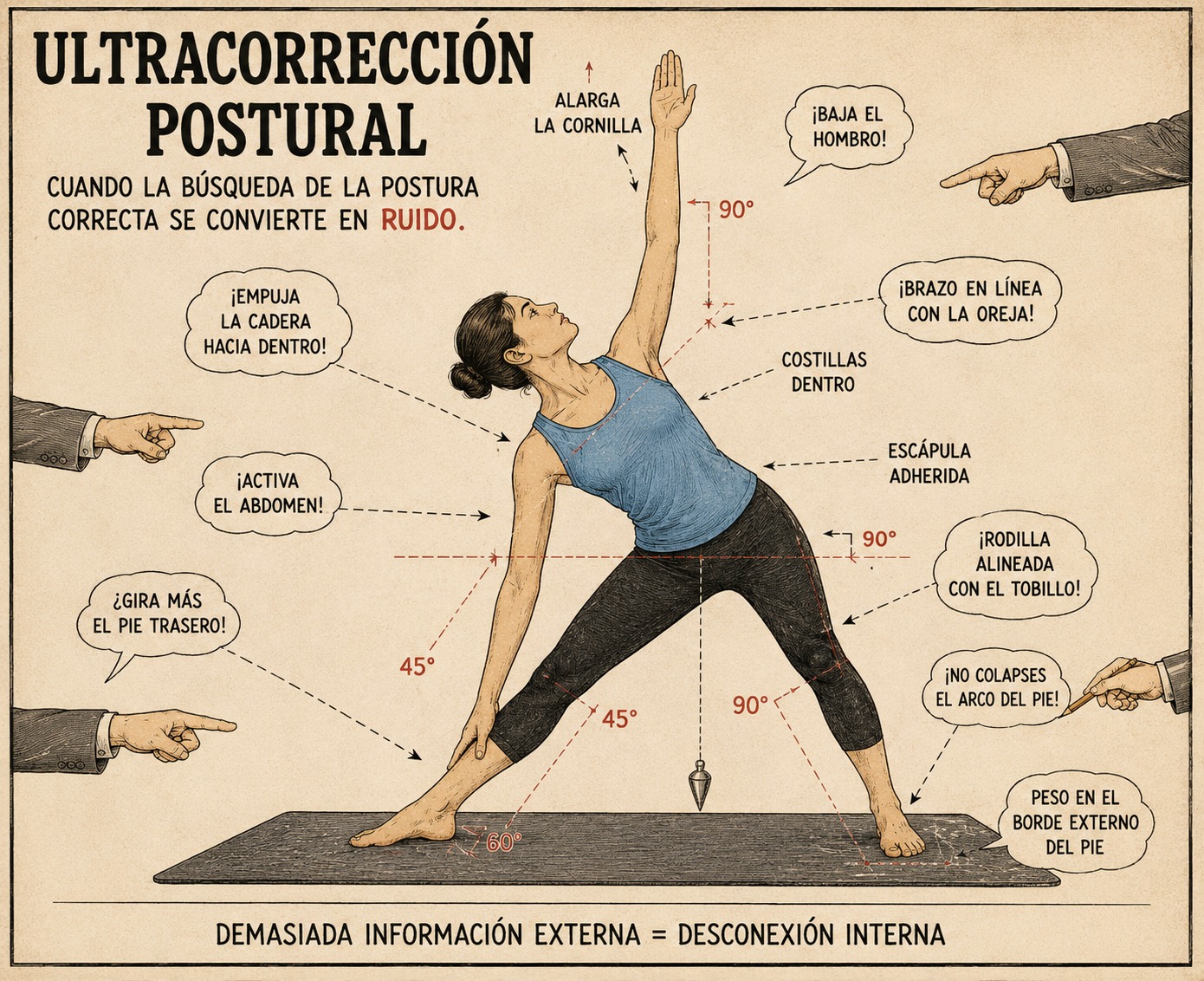
For a long time, part of yoga teaching has revolved around the search for the correct posture. Put your foot here. Turn your pelvis there. Align your knee. Drop your shoulders. Engage your core. Lengthen your spine. And just a little more.
Technical cues are necessary. They help us understand a posture, explore it, and, in certain cases, practise it more safely. But I also think there's such a thing as postural over-correction: that moment when the pile-up of instructions stops helping and starts turning into noise.
Because while we're trying to remember what to do with our big toe, our femur, our ribs and the crown of our head, we can end up forgetting to pay attention to the most important information of all: what's actually happening in our body.
Learning to listen
To me, one of the great lessons of yoga is precisely developing that capacity to listen. Learning to tell the difference between reasonable effort and the kind of pain that's telling us it might be better not to push. Recognising a limitation without experiencing it as a failure. Knowing when we can explore a little further and when it's better to back off. And understanding that our body isn't exactly the same every Tuesday at seven in the evening.
That's why I also try to leave room for silence during class. I firmly believe that, very often, silence is the best technical cue there is. It's the space in which you can notice what happens as you breathe, where a resistance shows up, which part of the body is working too hard, or what small adjustment makes a posture more stable. The posture then stops being a shape to reproduce and becomes something to investigate instead.
There's no such thing as the correct posture (or at least, not just one)
In yoga, we've inherited a lot of alignment instructions as if they described some ideal geometry of the body: the foot must point exactly here, the knee must sit right over the ankle, the pelvis must be positioned this way, the shoulders that way. Straying from the model then becomes a "mistake," and, all too easily, that mistake gets equated with a future injury.
But bodies aren't made from a single mould. Our proportions, our joint mobility, our strength, our age, our injury history and our anatomy all differ. And even the same person's body changes from one day to the next.
That doesn't mean alignment doesn't matter. Quite the opposite: alignment is a tool, not a dogma.
Biomechanics lets us understand, for example, that modifying a posture also changes the loads the body has to bear. A study carried out specifically on Trikoṇāsana — triangle pose — found that varying the distance between the feet changes the forces and joint moments at the ankles, knees and hips; what's more, those changes don't affect the front and back legs in the same way. The authors themselves suggest these variations could be used to increase or decrease certain loads and adapt the posture for beginners or people with specific needs.
That's why I'd rather talk about criteria than universal rules. An alignment cue can help us gain stability, shift a load, achieve a certain stimulus, or adapt a posture to a specific limitation. What's much harder to defend is the idea that there's a single, geometrically perfect alignment, valid for every body, that will by itself protect us from injury.
Pain is not your friend
It's a line I repeat quite often in class: pain is not your friend.
That doesn't mean every intense sensation is necessarily a sign of injury. Practice involves effort: muscles work, fatigue shows up, a posture can feel demanding, and we run into areas of resistance. Learning to recognise that reasonable effort is also part of the practice.
But effort is one thing, and pushing through when something hurts is another.
I have no interest in the idea — fairly widespread in exercise generally, and in some corners of yoga too — that you have to grit your teeth, push through the pain, or force it a little more to make progress. When pain shows up, my advice in class is usually much simpler: don't push through it. Come out of the posture, ease off, use a prop, or try a different variation.
Maybe you could go a little further. The question is whether you need to.
And this is where the ego inevitably shows up. The person on the mat next to you goes further. We ourselves went further yesterday. In the photo in that book, someone goes miles further. Everything nudges us toward turning the posture into a goal and the body into the obstacle standing between us and it.
I try to frame it exactly the other way round:
The posture should adapt to the body, not the body to the posture.
That means accepting that a smart practice doesn't always move toward "more": more flexibility, more depth, more difficulty. Sometimes moving forward means doing less. Using a prop. Bending a knee. Coming out of a posture early. Or deciding that, today, that posture just isn't for you.
Technique matters. Anatomy matters. A teacher's experience matters. But none of them should gradually replace a student's ability to listen to themselves. Quite the opposite: they should serve to develop it.
In the end, I care far more about a student learning to read their own body and make decisions than about them reproducing a posture exactly as it appears in a manual.
Because the goal isn't learning to endure more and more.
It's learning to listen to ourselves better and better.