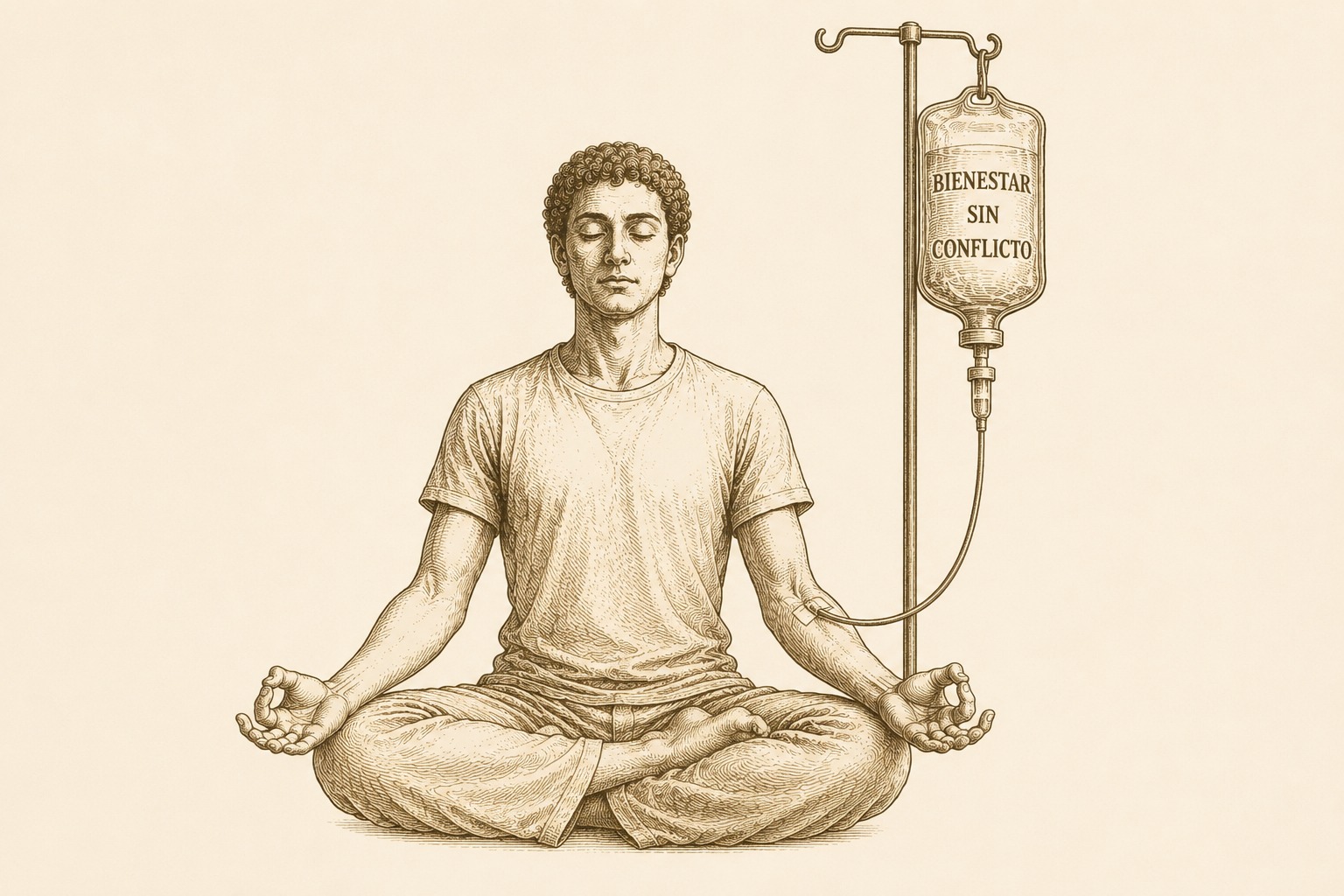
One of the things I value most about yoga is its ability to pull us out of the noise for an hour and a half. Practising, breathing, keeping quiet, leaving the wretched phone outside the room, and getting the mind to drop a few gears: after all these years, that little reset still feels to me like one of the great gifts of all this.
The problem starts when shelter turns into escape. Because we can also use yoga to avoid looking our problems in the eye, or to put up with situations we probably shouldn't be tolerating in the first place.
Breathe, adapt… and keep buying and producing
If you're exhausted, meditate. If you can't take work anymore, do yoga. If your life feels frantic, practise mindfulness. If reality distresses you, learn to manage your emotions better. And I'm not saying no — it's true that yoga can help a great deal with managing stress, and it will always be better to have tools for dealing with difficulty than to be overwhelmed by it. But learning to handle distress is one thing, and assuming its origin always lies within us is quite another.
This is where a certain wellness culture fits perfectly with a very individualistic view of life: the problem is always you, and so is the solution — YOUR attitude, YOUR habits, YOUR emotional management, YOUR ability to adapt.
Yoga then runs the risk of no longer helping us live better, and simply helping us COPE better.
This is one of the ideas from Conspirituality, by Derek Beres, Matthew Remski and Julian Walker, that interests me most: a certain kind of spirituality that presents itself as liberating can end up being deeply individualistic. The message is always some version of: be free, listen to your inner self, take charge of your life, create your own reality. The problem is that if everything depends on you, then everything that happens to you also ends up being your responsibility. Social, economic or workplace conditions vanish from the equation — and with them, the possibility of seeking collective solutions. If the problem is always within oneself, why bother trying to change the world around you?
What's curious is that you only need to go back to the classical yoga texts to find a rather different view.
Ethics comes first
In the Yoga Sūtras, ethics comes before postures, breathing or meditation. Patañjali opens the path of yoga with the yamas: ahiṃsā (non-violence), satya (truthfulness), asteya (not taking what isn't given), brahmacarya, and aparigraha (non-accumulation, non-attachment), listed in Yoga Sūtra II.30.
I find it telling that the eight-limbed path doesn't start by explaining how to position the body, but by laying out a way of relating to the world. And however much we go on to internalise those principles, they only make sense in relation to other people: ahiṃsā forces us to think about the harm we cause; satya, about our relationship with truth; asteya, about what we take from others; aparigraha, about our relationship with possession and accumulation.
It would be dishonest to turn Patañjali into a 21st-century social activist. The Yoga Sūtras were composed in a historical, religious and philosophical context very different from ours, and they contain no programme for political change. But it doesn't seem reasonable either to water those principles down into self-help tips along the lines of "five habits to find your best self."
The ethics of yoga has other human beings in front of it, not a mirror.
The idea comes through even more clearly in Yoga Sūtra I.33, where Patañjali proposes cultivating maitrī (loving-kindness) toward those who are happy and karuṇā (compassion) toward those who suffer, along with joy at what is virtuous and equanimity toward what isn't. Other people's suffering is right there, and our attitude toward it matters.
This also clears up a fairly common confusion: equanimity does not mean indifference. Detachment does not mean not caring about anything. We can try not to react out of anger and, at the same time, still consider something unjust. And pratyāhāra — the withdrawal of the senses — can be a formidable tool for reclaiming control of our attention, without that meaning we also withdraw from society.
In certain corners of the yoga world there seems to be an unspoken rule that you should stay apolitical. The good yogi observes, accepts, doesn't judge, keeps their equanimity, and, if at all possible, doesn't get mixed up in anything.
There's a belief that if you meditate enough, if you become conscious enough, the world will improve almost by osmosis — as if the common good were simply the automatic sum of enough enlightened individuals, rather than the result of organising, demanding, voting, negotiating, or making the right people uncomfortable when it's called for.
Neither incense nor anaesthetic
Of course, yoga doesn't need to turn into a political programme. But I do think it's fair to ask it for the opposite of what it sometimes offers: that instead of anaesthetising us, it wakes us up. That the calm we find on the mat doesn't become the perfect excuse not to see what's happening off it, but instead becomes the clarity we need to deal with problems more effectively.
No structural problem — precarity, inequality, climate breakdown, whatever injustice you like — gets solved by burning incense or perfecting your breathing.
That's not what yoga promises, and treating it as if it did is, at best, a very convenient way of doing nothing at all. If a practice makes us calmer but also more indifferent to what happens to other people, then it isn't enlightening us. Not one bit.
— Yoga Grund Málaga
Further reading
Patañjali, Yoga Sūtras, especially I.33 (on maitrī and karuṇā) and II.29–31 (the eight limbs of yoga and the yamas).
Bhagavad Gītā, chapters III (karma yoga) and V (renunciation and action).
Beres, D.; Remski, M.; Walker, J. Conspirituality. Public Affairs, 2023.
Welwood, J. Toward a Psychology of Awakening. Shambhala, 2000. (Origin of the concept of "spiritual bypassing.")
Rosen, A. "Balance, Yoga, Neoliberalism." Signs and Society, 2025.